
Written by Bryant Gan, Founder, Niagawan · Last updated 14 September 2026
Sometimes the same company is your customer and your supplier. They owe you money, but at the same time, you also owe them money. Instead of both sides making separate payments, you can agree to contra the amounts and just pay the balance. Example: You owe your supplier RM1,780, while they owe you RM1,290. Contra RM1,290, and you only need to pay the remaining RM490.
Your supplier has just asked to "contra" the invoices. Or a customer who also sells to you is paying late, but you still owe them for last month's stock. Or your statement of account shows a line that says contra, and the balance suddenly dropped.
In all three cases, the question is the same: do you still need to pay the full amount?
Quick answer: no. If both sides agree to a contra payment, you only pay the difference. In this guide: what contra payment means, an RM example, a free contra agreement letter you can download, and how to record it so your reports stay correct.
01. Contra Payment In One Minute: Do You Have To Pay The Full Amount?
Here is the idea in three numbers (an example — section 03 explains it):
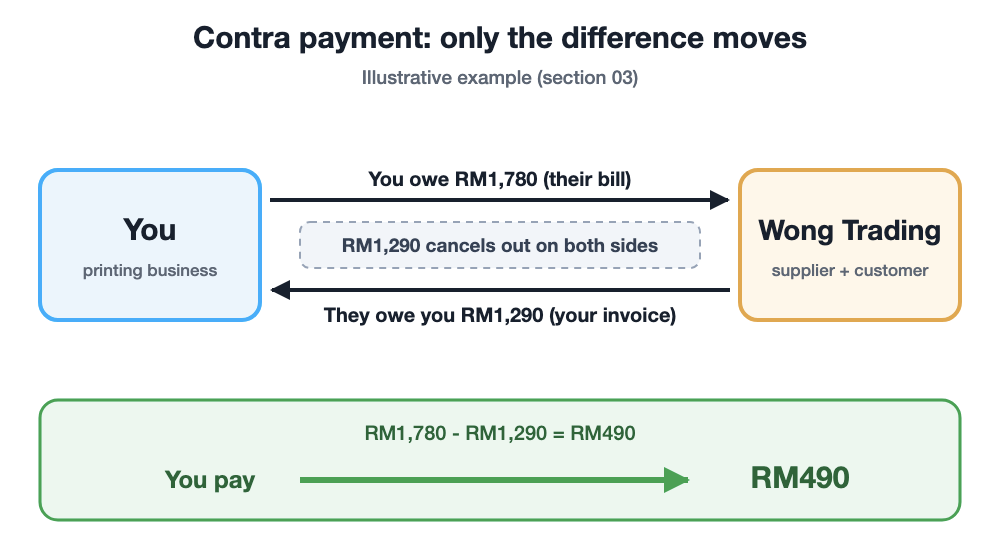
| What | Amount |
|---|---|
| You owe Wong Trading (their supplier bill) | RM1,780 |
| Wong Trading owes you (your sales invoice) | RM1,290 |
| What you actually pay after the contra | RM490 |
The 20-second answer. Contra payment is simple. If you buy from a company and they also buy from you, you can contra both unpaid amounts and just pay the difference. It only works when both sides agree, and it's best kept in writing.
Not the same as a “contra entry” (moving your own cash into the bank) or a “contra account” — see section 12.
02. Can One Company Be Both Your Customer And Your Supplier?
Yes. If you sell to a company and also buy from them, they appear in both your customer records and your supplier records.
In accounting, a customer who owes you money is called a debtor (they owe you a debt), and a supplier you owe money to is called a creditor. Everything your debtors owe you, added up, is your accounts receivable.
| Relationship | They are your… | Where it shows |
|---|---|---|
| You sell to them on credit | Debtor (customer) | Customer list — what customers owe you (debtor aging) |
| You buy from them on credit | Creditor (supplier) | Supplier list — what you owe suppliers (creditor aging) |
| Both at once | Debtor and creditor | On both lists — this is when you can contra |
Some everyday examples of a customer who is also a supplier:
- A printing shop buys paper from a trading company, and that trading company orders printed boxes from the printing shop.
- A café buys cakes from a bakery, and the bakery buys its coffee beans from the café.
- A contractor buys materials from a hardware supplier, and the hardware supplier hires the same contractor to renovate its shop.
A contra only applies to credit sales and purchases, where the amounts are still unpaid. If you were paid on the spot, as with cash sales, there is nothing left to contra.
👉 Checkpoint: Is this company on both your customer list and your supplier list, with unpaid amounts on both sides? If yes, read on. If only one side owes money, there is nothing to contra — just make a normal payment.
03. Example: You Owe RM1,780, They Owe You RM1,290. How Much Do You Pay?
Example only — the company names and figures are not real.
You run a printing business. Wong Trading supplies your paper, and they also order printed boxes from you.
- Wong Trading sent you the supplier's bill (purchase invoice) for RM1,780 for paper. You haven't paid it yet.
- You sent Wong Trading your sales invoice for RM1,290 for printed boxes. They haven't paid you yet.
Without a contra, both sides make separate payments: you transfer RM1,780 to Wong, and Wong transfers RM1,290 to you. That's RM3,070 in transfers to settle a RM490 balance.
With a contra, both sides agree to contra RM1,290, so you only pay the RM490 balance.
The rule: you contra the smaller amount (or a lower amount, if both sides agree). Here, the smaller amount is RM1,290.
The calculation, step by step:
- What Wong owes you: RM1,290 − RM1,290 contra = RM0
- What you owe Wong: RM1,780 − RM1,290 contra = RM490
- You pay Wong RM490: RM490 − RM490 = RM0
Check: 1,780 − 1,290 = 490 ✔
| Stage | Wong owes you | You owe Wong |
|---|---|---|
| Before the contra | RM1,290 | RM1,780 |
| After the RM1,290 contra | RM0 | RM490 |
| After you pay the RM490 | RM0 | RM0 |
Contra does not delete or reduce either invoice. Both stay at their full amounts — your sales still include the RM1,290 invoice, and your purchases the RM1,780 bill. Contra only reduces the amount you actually pay.
04. Download The Free Contra Agreement Letter (Word And PDF)
A contra only works if both companies record the same contra amount. The easiest way is a short letter, signed by both companies, that lists exactly which invoices are included.
Free, editable, no sign-up:
What the letter covers: both company names and registration numbers, the date, every invoice included, the contra amount, the balance and who pays it, when it will be paid, the reference both sides will use, and signatures with company stamps.
Here is the letter filled in with the section 03 figures:
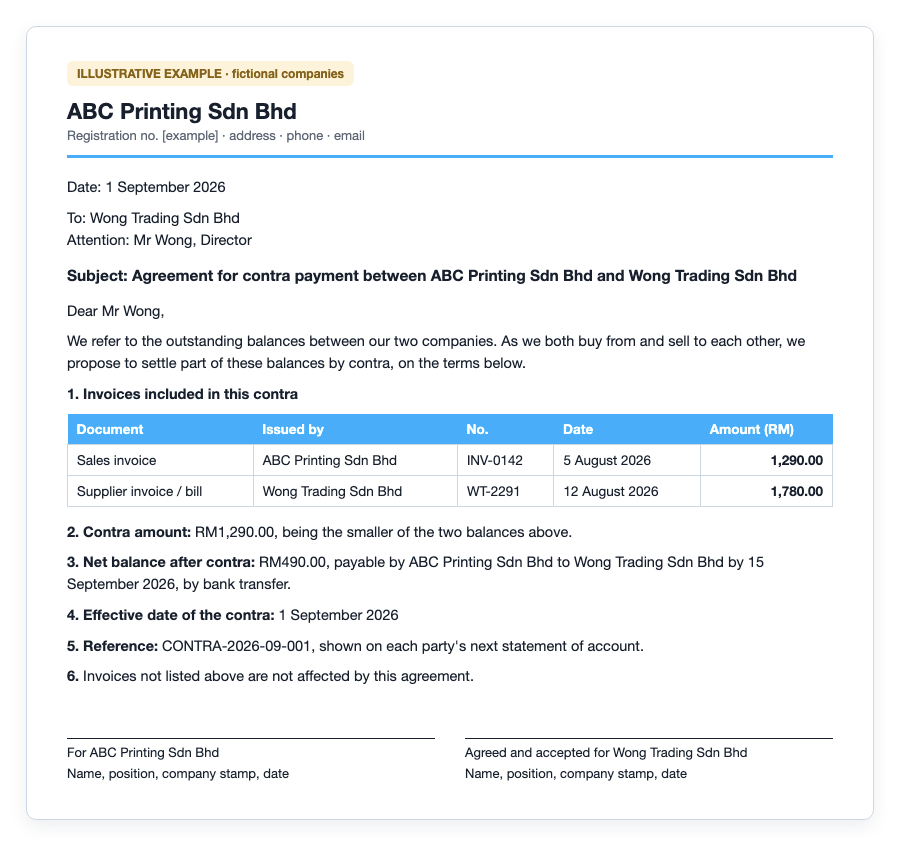
This is a practical template, not legal advice. For large amounts or anything unusual, ask your accountant to check it first.
The Contra Payment Letter Template
[Your company letterhead: company name, registration no., address, phone, email]
Date: [DD Month YYYY]
To:
[Other company name]
[Registration no.]
[Address]
Attention: [Name, position]
Subject: Agreement for contra payment between [Your company name] and [Other company name]
Dear [Name],
We refer to the outstanding balances between our two companies. As we both buy from and sell to each other, we propose to settle part of these balances by contra, on the terms below.
1. Invoices included in this contra
| Document | Issued by | No. | Date | Amount (RM) |
|---|---|---|---|---|
| Sales invoice | [Your company name] | [Invoice no.] | [Date] | [Amount] |
| Supplier invoice / bill | [Other company name] | [Invoice no.] | [Date] | [Amount] |
2. Contra amount: RM[amount], being the smaller of the two balances above (or: an amount both parties agree).
3. Net balance after contra: RM[amount], payable by [Your company name / Other company name] to [the other party] by [date], by [bank transfer / cheque].
4. Effective date of the contra: [Date]
5. Reference: Both parties will record this contra under the reference [e.g. CONTRA-YYYY-MM-001], and it will appear on each party's next statement of account.
6. Invoices not listed above are not affected by this agreement and will be settled on their normal terms.
Please sign and stamp below to confirm your agreement, and return a copy to us.
Yours sincerely,
Signed for and on behalf of [Your company name]:
______________________
Name: [Name]
Position: [Position]
Company stamp:
Date:
Agreed and accepted for and on behalf of [Other company name]:
______________________
Name: [Name]
Position: [Position]
Company stamp:
Date:
Prefer Email? A Short Request For Contra Payment
If you already work closely with the other company, an email reply confirming the same details can be enough. Keep the reply with your records.
Subject: Request for contra payment — [Your company] / [Other company]
Hi [Name], we'd like to contra your invoice [no.] for RM[amount] against our invoice [no.] for RM[amount]. After the contra, [we / you] will pay the balance of RM[amount] by [date]. Could you reply to confirm so both our accounts teams can record it under reference [reference]?
05. When Should You Use Contra?
A contra is useful, but it isn't always the right choice. If you contra the wrong amount, your records may not match later.
| Situation | Contra? | What to do |
|---|---|---|
| Both sides agree on the amount | ✅ Good fit | Put the amount in writing and record it on both sides |
| One invoice is disputed, or goods were returned | ⏸️ Not yet | Sort out the dispute first — issue a credit note first for returns or overcharges, or a debit note for an undercharge — then contra the corrected amount |
| The invoices are under different company names | ⚠️ Ask first | Don't contra them automatically. Even if the companies have the same owner, they are separate businesses. Check with your accountant first |
| The two invoices have very different due dates | ✅ If agreed | Agree on the contra date, so neither side shows the amount as overdue by mistake |
| The customer pays slowly, and you also owe them | ✅ Often helpful | Contra can help reduce the amount you need to pay now — but only if they agree. Never quietly hold back payment |
| Paying the supplier early gets you a discount | 🤔 Compare | Check which saves you more — the discount or the contra — then decide |
| You buy and sell with each other every month | ✅ Regular contra | Agree on a monthly contra and show it on the statement of account |
You can always say no. Both sides must agree to a contra. If you prefer to collect and pay normally, that's fine.
👉 Checkpoint: No disputes and both sides agree? Go to the 5 records in section 06. Something disputed? Fix it first with a credit or debit note.
06. Doing A Contra? Keep These 5 Records
- ✅ Your sales invoice (in full, RM1,290)
- ✅ The supplier's invoice (in full, RM1,780)
- ✅ The signed contra letter or the email confirming it
- ✅ Each side's next statement of account, showing the contra
- ✅ Proof of the RM490 payment (a payment voucher on your side)
These records make it clear how much each side owed and how the contra was settled. Keeping them is good practice, not a specific rule.
07. What Happens To Both Unpaid Amounts After Contra?
In accounting software, what customers owe you shows in the debtor aging report, and what you owe suppliers shows in the creditor aging report — see the aging report guide.
Before the contra:
| Report | Wong Trading balance |
|---|---|
| Debtor aging (what Wong owes you) | RM1,290 |
| Creditor aging (what you owe Wong) | RM1,780 |
After the contra, and after you pay the RM490:
| Stage | Debtor aging | Creditor aging |
|---|---|---|
| After the contra | RM0 | RM490 |
| After paying RM490 | RM0 | RM0 |
Don't worry if Wong Trading appears in both reports. One shows what they owe you, and the other shows what you owe them.
The problem starts when a contra is agreed but not recorded. Your debtor aging still shows Wong owing you RM1,290, so someone may chase money that was already settled. Your creditor aging still shows RM1,780, so someone may pay the full bill by mistake.
08. How Do You Record A Contra Yourself?
For Business Owners
Record both invoices at their full amounts. Contra RM1,290 on what Wong owes you and on what you owe Wong. Then record the RM490 payment as usual.
For Your Bookkeeper: The Accounting Entry
"Dr" (debit) and "Cr" (credit) are the two sides every entry needs.
| Step | Entry | RM |
|---|---|---|
| 1. The contra | Dr Trade payables — Wong Trading (what you owe them) | 1,290 |
| Cr Trade receivables — Wong Trading (what they owe you) | 1,290 | |
| 2. Pay the balance | Dr Trade payables — Wong Trading | 490 |
| Cr Bank | 490 |
Check: what you owe Wong falls by 1,290 + 490 = 1,780 (bill cleared); what Wong owes you falls by 1,290 (invoice cleared). ✔
Two traps:
- Recording only the RM490 balance — sales and costs both show lower than they should.
- Recording the contra on one side only — the other list will be wrong.
The limit of doing it by hand. If you record contra manually in Excel, you need to update both the customer and supplier records correctly. Miss one side, and your outstanding amounts won't match.
09. How Do You Record A Contra In Niagawan?
Niagawan is cloud accounting software for Malaysian businesses. A contra works the same way as in section 08, but your invoices, supplier bills and aging reports are all in one place:
- Set up a payment source named "Contra Payment" once, in Settings, where you add your bank and cash payment sources.
- Record both documents in full — your sales invoice to Wong Trading (RM1,290) and Wong's supplier bill (RM1,780).
- Settle RM1,290 on each document using the "Contra Payment" source — once on the sales invoice, once on the supplier bill.
- Record the RM490 balance as a normal payment on the supplier bill, from your bank or cash source.
Both documents then show as settled. What the customer owes you and what you owe the supplier update together, and your debtor and creditor aging reports show it — no separate spreadsheet.
Niagawan Plus — invoices, supplier bills and aging in one record. RM497 a year (excluding SST), with 3 user IDs included. Includes customer and supplier aging reports, financial reports, digital invoicing and bank reconciliation.
Trusted by 40,000+ Malaysian businesses since 2016 · 4.7★ on Google (500+ reviews). See Niagawan
10. Before You Contra An Invoice: 10 Things To Check
Most contra problems start before anything is recorded — with an amount nobody checked properly.
Save this before you sign
- ✅ Both sides' statements of account show the same amounts
- ✅ Every invoice in the contra is listed by number, date and amount
- ✅ Any disputes or returns are sorted out first (credit or debit notes issued)
- ✅ The contra amount is the smaller amount, or a lower amount you both agree on
- ✅ It's clear who pays the balance, and by when
- ✅ Both sides agree on the contra date
- ✅ Someone with authority signs for each company
- ✅ Both accounts teams know about it
- ✅ The contra shows on the next statement of account
- ✅ If you're not sure about any tax effect, you've checked with your accountant or tax agent
11. Common Contra Mistakes
| ❌ Mistake | What goes wrong | ✅ Do this instead |
|---|---|---|
| Recording only the balance | Sales and purchases both show lower than they should | Record both invoices in full, then the contra, then the balance payment |
| Cancelling or deleting one invoice | The sale or purchase goes missing from your accounts | Don't delete it — mark it settled by contra |
| Contra on a disputed invoice | You contra an amount that changes later | Sort out the dispute with a credit or debit note first |
| No written agreement | Nobody can prove what was agreed | Use the letter in section 04, or get an email confirmation |
| Only one side records the contra | Your statements of account won't match | Agree on one reference number for both sides |
Rule of thumb: make sure both companies agree on the same invoices, amount, date and reference before anyone records the contra.
12. Contra Payment vs Contra Entry: What's The Difference?
Search for "contra" and you'll find a few accounting terms that sound alike, but they mean different things.
| Term | What it means | Who's involved |
|---|---|---|
| Contra payment | Using what another business owes you to reduce what you owe them, then paying the balance | You and one other business |
| Contra entry | Moving money between your own cash and bank, such as banking the day's cash | Only you |
| Contra account | An account used to reduce another figure in your reports, such as depreciation lowering your equipment's value | Only your books |
| Knock-off | Matching a payment, credit note or contra to an invoice so it shows as settled | Your own records |
Matching your cash and bank records instead? See bank reconciliation.
In short, the contra payment meaning is simple: when a customer is also your supplier, you only pay the balance after contra. Agree it in writing, record both invoices in full, and your aging reports and statements will stay correct.
Frequently Asked Questions
What Does Contra Mean In Accounting?
"Contra" means against. It means one amount reduces another, such as what a company owes you reducing what you owe them.
What Is A Contra Payment Example?
You owe a supplier RM1,780 and they owe you RM1,290. You both agree to contra RM1,290, so you only pay RM490.
Is A Debtor A Customer Or A Supplier?
A debtor owes you money, usually a customer. A creditor is someone you owe, usually a supplier. One company can be both.
Do I Still Issue The Invoice In Full If We Contra?
Yes. Both the sales invoice and the supplier bill stay at their full amounts. The contra only settles the unpaid amounts.
Can We Contra Only Part Of The Balance?
Yes, if both sides agree. The contra is usually up to the smaller amount. The rest is paid normally.
Do I Need A Letter For A Contra Payment?
It's strongly recommended. A signed letter or email confirmation helps both sides record the same amount, so their statements match.
Does A Contra Change My SST Or e-Invoice?
A contra changes how the unpaid amounts are settled. It doesn't replace the original sale or purchase documents. If SST or e-Invoice applies, keep the original documents, and check with your tax agent if you're unsure how to record the contra.