Written by Bryant Gan, Founder, Niagawan · Last updated 5 August 2026
A payment voucher is an internal document a business fills in to authorise and record a payment before the money leaves — who is being paid, how much, what for, and who approved it.
It is not the supplier's invoice, and it is not the receipt they hand you. Those are their documents. The payment voucher is yours: the one piece of paper that says this payment was checked and approved by a named person before anybody touched the bank account.
Most small businesses in Malaysia meet this document the same way.
An accountant, an auditor or a suspicious business partner asks: who approved this RM3,400? And the honest answer is that nobody did — because nobody was ever asked to.
A payment voucher takes two minutes. It exists so that question always has an answer.
This guide gives you the blank form in Word, Excel and PDF, then shows you exactly how to fill it in, what to file behind it, and how it differs from a receipt, an invoice and a petty cash voucher.
01. What A Payment Voucher Is, In One Line
A payment voucher is the form your business completes to approve and record money going out.
It does two jobs, and they happen at different moments:
- Before the payment — authorisation. Someone prepares it, someone else approves it. The approval is the whole point.
- After the payment — the record. It becomes the entry in your books, with the supplier's invoice and the bank proof filed behind it.
02. Download The Blank Payment Voucher
Free, no sign-up, RM-ready. Print a stack and keep it with the cheque book, or fill it in on screen.
Free · No sign-up · RM-ready · Works on your phone or PC.
One or two vouchers a month? The template is all you need.
Doing this every week? Instead of writing the voucher separately and then recording the same payment again, you can record the payment and create the payment voucher from the same payment flow in Niagawan.
See how Payment Vouchers work in Niagawan →03. Every Field, And What Goes Wrong When You Skip It
The form is short. Each field is on it for a reason — and the ones people leave blank are the ones that cause the arguments later.
| Field | What goes in it | What goes wrong if it's blank |
|---|---|---|
| Voucher number | A sequential number, never reused | Your books and your paperwork can't be matched to each other |
| Date | The date the payment is approved | You can't tell which month the expense belongs to |
| Paid to | The full legal name of the supplier or person | "Ahmad" is not a payee. Three months later nobody knows which Ahmad |
| Being paid for | What the money buys, in plain words, with the invoice or DO number | The most common gap of all. "Payment" is not a description |
| Amount (figures) | 1,240.00 | — |
| Amount (words) | Ringgit Malaysia One Thousand Two Hundred and Forty Only | The classic protection against a figure being altered after approval |
| Payment method | Cash, cheque, bank transfer, DuitNow | You can't trace it back to the right line on the bank statement |
| Cheque / reference no. | The cheque number or the transfer reference | The only thing tying this form to an actual movement of money |
| Account / category | The expense category or GL code it's posted to | The payment gets recorded, but not where — so your reports are wrong |
| Prepared by | The person who wrote it up | — |
| Approved by | Someone other than the preparer | Without this the voucher proves nothing. This is the field that matters |
| Received by | Signed by whoever takes the money, for cash payments | For cash, this is your only proof it reached the right hands |
The salary row is the one that catches small employers out. Paying wages outside a payroll run usually means one of two things: a final settlement, or an advance salary — and an advance is not a wage cost on the day it goes out, it is money owed back to you. Attach the signed advance agreement behind the voucher, not just a salary slip.
The amount in words is not old-fashioned formality. A "1" can become a "7". A "0" can be added to the end of a figure. Words cannot be edited quietly. It costs three seconds, and it is one of the oldest controls in bookkeeping for a reason.
04. A Filled Example: Paying A Supplier RM1,240
Here is a normal payment, written up properly. A packaging supplier delivered stock on the 14th and invoiced RM1,240.
| Field | What was written |
|---|---|
| Voucher no. | PV-2026-0087 |
| Date | 21 August 2026 |
| Paid to | Kilang Pembungkusan Maju Sdn Bhd |
| Being paid for | Carton boxes and tape — Invoice INV-4471, DO 2210 |
| Amount | RM 1,240.00 |
| In words | Ringgit Malaysia One Thousand Two Hundred and Forty Only |
| Payment method | Bank transfer (DuitNow) |
| Reference | TXN 8840119226 |
| Category | Packaging materials |
| Prepared by | Store clerk |
| Approved by | Owner / manager |
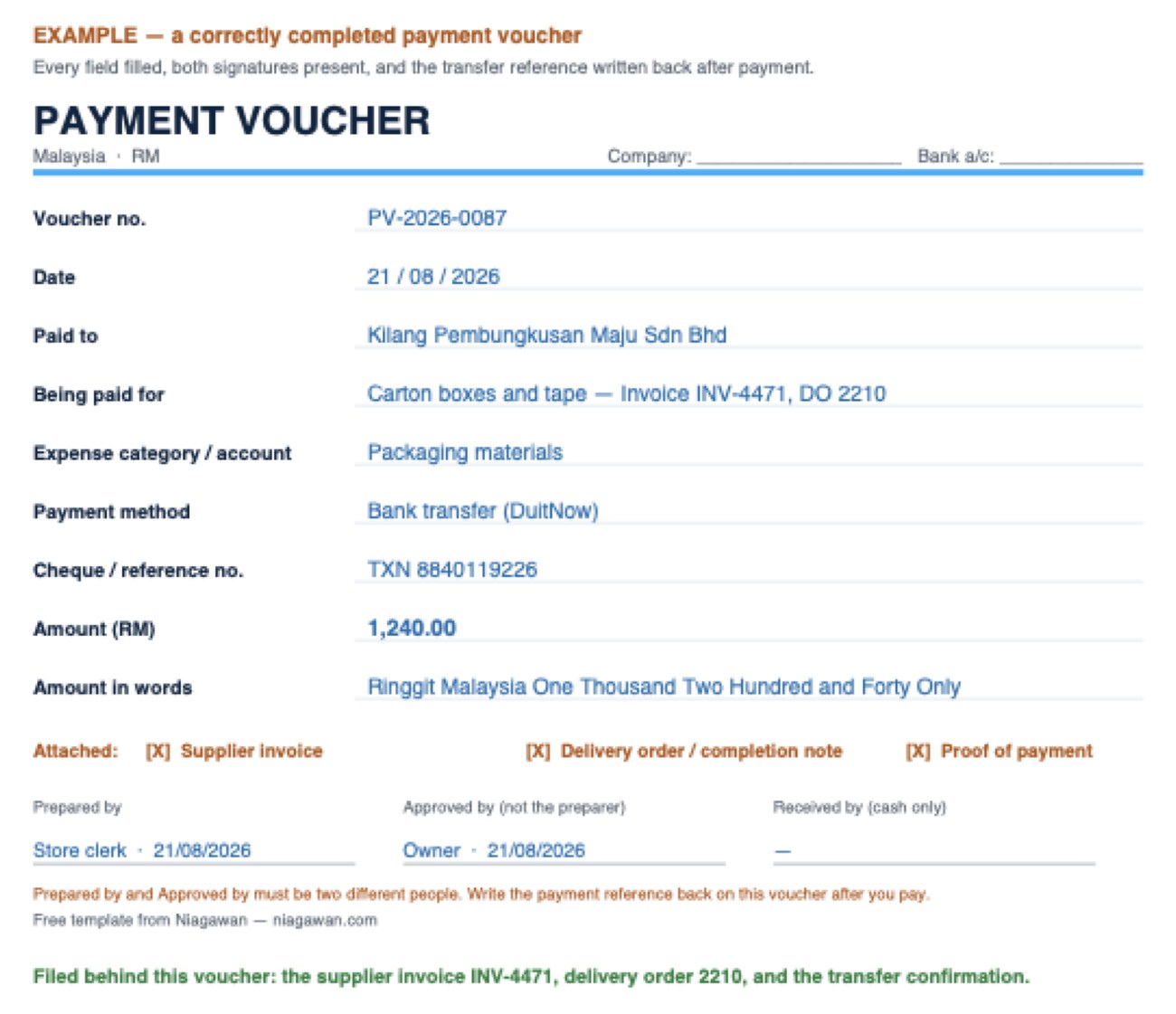
Behind it, stapled: the supplier's invoice, the signed delivery order, and the transfer confirmation.
That's the whole exercise. Two minutes. What it buys you is that in eight months, when the supplier claims this invoice was never settled, the answer takes ten seconds instead of an afternoon.
05. Payment Voucher vs Receipt, Invoice And Purchase Order
This is the confusion that sends most people looking for this page, so here it is in one table.
| Document | Who writes it | When | What it proves |
|---|---|---|---|
| Purchase order | You | Before anything is delivered | You ordered it, at an agreed price |
| Invoice | The supplier | After delivery | They are asking you to pay |
| Payment voucher | You | Just before you pay | The payment was checked and approved internally |
| Receipt | The supplier | After you pay | They confirm they received the money |
So what is the difference between a payment voucher and a receipt? A receipt comes from the person you paid and confirms they got the money. A payment voucher is written by you, before the money goes, and records that the payment was approved. One is external proof of receipt; the other is internal proof of authorisation. You normally end up holding both, filed together. When the money flows the other way and a customer pays you, the paper you give them is an official receipt.
Two more you may hear:
- Cash voucher — usually just a payment voucher for a cash payment. Same form, cash ticked.
- Journal voucher — not a payment at all. It records an accounting adjustment where no money moves, like a correction or a depreciation entry.
06. Cash, Bank, Salary Or Petty Cash — Which One Do You Need?
One form covers nearly everything. What changes is the method, and what you attach.
| Type | When you use it | What must be attached |
|---|---|---|
| Cash payment voucher | You hand over physical cash | Receipt, plus the payee's signature on the voucher itself |
| Bank payment voucher | Cheque, transfer, DuitNow, standing instruction | Invoice, plus the transfer confirmation or cheque number |
| Salary payment voucher | Paying wages outside a payroll run | The payroll summary or salary slip. Never a bare voucher on its own |
| Petty cash voucher | Tiny amounts out of the cash box | Receipt only — this one is a different, smaller form |
| Expense claim | Staff paid with their own money and want it back | Their receipts, listed on an expense claim form — not a voucher at all |
A petty cash voucher is not the same document. It covers small amounts — parking, a courier, printer paper — paid out of a fixed cash float, and it usually needs no invoice because there isn't one. A payment voucher is the general authorisation for any payment, including large ones going out of the bank. If the money comes out of the tin, use a petty cash voucher. If it comes out of the bank, use a payment voucher.
07. Who Signs It, And Why One Signature Isn't Enough
Three roles, and they should not all be the same person:
- Prepared by — whoever writes the voucher up from the invoice
- Approved by — the person with the authority to release the money
- Received by — for cash, the person who physically takes it
In a business with three staff that sounds bureaucratic. It isn't — it is the reason a supplier can't be invented, an invoice can't be paid twice, and an amount can't quietly grow between the request and the bank.
If you are a one-person business, you approve your own vouchers, and that is fine. The document still earns its place: it forces you to write down what the payment was for, at the moment you actually know.
08. Numbering Your Vouchers So They Can Be Audited
Give every voucher a number the day you start, and never break the sequence.
A scheme that works for a small business:
- PV-2026-0001, PV-2026-0002, and so on — prefix, year, then a running number
- If you pay from more than one bank account, add a letter: PV-A-2026-0001
- Never reuse a number. If a voucher is cancelled, write CANCELLED across it and keep it in the file
- Never leave a gap. A missing number is the first thing anyone reviewing your books will ask about
The number is what ties three separate things together — the entry in your accounts, the paper in the file, and the line on your bank statement. Without it you have three lists that can't be reconciled to one another.
09. What To File Behind It
Staple, don't paperclip. Paperclips separate in a file.
| Attach this | Because it proves |
|---|---|
| The supplier's invoice | The reason for the payment, and the amount |
| The delivery order or job completion note | You actually received what you're paying for |
| The purchase order or quotation | The price was agreed in advance, not decided afterwards |
| The approval | A signature, or the printed email if it was approved that way |
| Proof of payment | The transfer confirmation, cheque counterfoil, or receipt |
If a payment has no supporting document at all, that is worth a pause. Occasionally it's legitimate. Usually it means somebody skipped a step.
One payment will look smaller than the invoice behind it: the net balance you pay after a contra payment, where a supplier who is also your customer offsets what you owe each other. File the signed contra letter behind that voucher, so the gap between the bill and the payment explains itself.
10. How It Works, Start To Finish
- The invoice arrives from the supplier
- Someone checks it against the delivery — right goods, right quantity, right price
- A payment voucher is prepared, with the invoice number written into the description
- It goes to the approver, who signs it
- The payment is made — cheque, transfer or cash
- The reference number is written back onto the voucher
- Everything is stapled and filed by voucher number, and the expense is entered into the accounts
Step 6 is the one that gets skipped, and it's the one that makes the file useful. A voucher without a payment reference tells you a payment was approved. It doesn't tell you it happened.
11. When You Honestly Don't Need One
Not every business needs a voucher for every payment, and pretending otherwise just means the forms stop being filled in.
- Direct debits and standing instructions — rent, insurance, subscriptions. Approve the arrangement once, in writing; you don't need a voucher every month
- Payments already approved in a payroll run — the payroll record is the approval
- Very small cash payments — that's what a petty cash voucher is for
What genuinely does need one: any payment to a supplier, any one-off payment above whatever limit you set, anything paid in cash, anything paid to a person rather than a company, and anything at all that someone will ask about later.
A Voucher File Proves One Payment. A System Shows The Whole Supplier.
- Every payment recorded against the supplier and the expense category
- AR/AP aging — see what is owed and what is still outstanding
- Cloud accounting and POS built for Malaysian SMEs — 40,000+ businesses since 2016
12. From A Paper Pad To A System
A printed voucher pad from the stationery shop works perfectly well. It just doesn't add itself up.
The point at which businesses move on is usually not the paperwork — it's the reporting. A drawer of vouchers can tell you what one payment was for. It cannot tell you what you spent with that supplier this year, what's still outstanding, or which category is running over.
That's what recording payments in your accounting system does: every payment goes in against the supplier and the expense category, so what you approved on paper becomes a supplier balance you can actually see. Niagawan Plus records your expenses and payments in one place, with AR/AP aging so you can see what's owed and what's outstanding per supplier, plus expense analytics, financial reports, digital invoicing and bank reconciliation, so you can check each payment against the bank statement month by month.
Niagawan Plus is RM497 a year with three user IDs. Built for Malaysian businesses — RM, SST and e-Invoice handled — and used by over 40,000 businesses since 2016.
Keeping the paper voucher alongside a system is not duplication. The voucher carries the approval; the system carries the record. Most well-run small businesses do both, and the voucher file is what an auditor asks for first.
Still choosing what to run your books on? See our guide to accounting software for a small business, the comparison of the best accounting software in Malaysia, or cloud vs desktop if you're moving off an old system. Related basics: petty cash, invoicing in Malaysia and the proforma invoice.
13. What Most Businesses Get Wrong
| The mistake | What it looks like | The fix |
|---|---|---|
| 1. "Payment" as the description | Every voucher says the same word. None of them explain anything. | Write the invoice or DO number into the description, every time. |
| 2. Approved by the person who prepared it | One signature, or the same handwriting twice. | Second signature, always — even if the second person is the owner. |
| 3. Filled in after the money has gone | A stack written up at month-end from bank statements. | The voucher is the approval. Approval after payment is just typing. |
| 4. No payment reference written back | The voucher stops at "bank transfer". | Write the transaction reference on the voucher when you make the payment. |
| 5. Numbers reused or skipped | Two PV-0043s, or a jump from 51 to 56. | One unbroken sequence. Cancelled vouchers stay in the file. |
| 6. Nothing stapled behind it | A tidy voucher file with no invoices in it. | The voucher is the cover sheet, not the evidence. |
The pattern in all six is the same: the form gets filled in, but the thing the form exists to capture — a named person checking a specific payment before it went out — never actually happened.
✓ One number per voucher. Sequential, never reused, never skipped.
✓ Say what the money bought. With the invoice or DO number on it.
✓ Two signatures. The preparer never approves their own request.
✓ Write the payment reference back after the money goes out.
✓ Staple the evidence behind it. Invoice, delivery note, proof of payment.
Bryant Gan is the Founder of Niagawan — the cloud accounting and POS system used by more than 40,000 businesses in Malaysia since 2016. He has spent over 10 years building software that helps Malaysian SMEs keep their books, stock, and tax records in order.
Frequently Asked Questions
What Is A Payment Voucher?
A payment voucher is an internal document a business uses to authorise and record a payment before the money goes out. It records who is being paid, how much, what for, how it's being paid, and who approved it — and the supplier's invoice and proof of payment are filed behind it.
What Is An Example Of A Payment Voucher?
A typical one: voucher PV-2026-0087, dated 21 August 2026, paid to Kilang Pembungkusan Maju Sdn Bhd, RM1,240.00 for carton boxes against invoice INV-4471, paid by bank transfer with the transaction reference written on, prepared by the store clerk and approved by the owner. Section 04 above shows the full version, and the filled PDF is free to download.
How Does A Payment Voucher Work?
The supplier's invoice is checked against what was actually delivered, a voucher is prepared with the invoice number on it, an approver signs it, the payment is made, the payment reference is written back onto the voucher, and the whole set is stapled and filed by voucher number.
What Is The Difference Between A Payment Voucher And A Receipt?
A receipt is issued by the person you paid and proves they received the money. A payment voucher is written by you, before you pay, and proves the payment was approved internally. One is external, one is internal — and you normally file both together.
What Is The Difference Between A Payment Voucher And An Invoice?
The supplier writes the invoice to ask you for money. You write the payment voucher to approve paying it. One is a request from outside; the other is an authorisation from inside.
What Is The Difference Between A Payment Voucher And A Journal Voucher?
A payment voucher records money actually leaving the business. A journal voucher records an accounting adjustment where no money moves at all — a correction, a reclassification, or a depreciation entry.
Is A Payment Voucher A Legal Requirement?
No law requires the form itself. What you do have to be able to do is support your business expenses with proper records — and a numbered voucher with the invoice and payment proof attached is the simplest way to have that ready before anyone asks.
Does A Payment Voucher Have To Be Signed?
Yes, in practice. An unsigned voucher records that a payment was made but not that anyone authorised it, which removes the main reason for having one. At minimum: prepared by, approved by, and for cash payments, received by.
Can A Payment Voucher Be Digital?
Yes. An approval by email, an e-signature, or an approval step in your accounting system all work, as long as the approval is recorded and traceable to a person. What doesn't work is a form filled in with no approval anywhere.
What Supporting Documents Go With A Payment Voucher?
The supplier invoice, the delivery order or completion note, the purchase order or quotation if there was one, the written approval, and the proof of payment — transfer confirmation, cheque counterfoil, or receipt.
Do I Need A Payment Voucher If I Already Use Online Banking?
The bank record shows money moved and to whom. It doesn't show what it was for or who approved it, and “TRANSFER TO MAJU SDN BHD” is not a business purpose. The voucher is what supplies the missing half.
How Should I Number Payment Vouchers?
One unbroken sequence, prefixed and dated — PV-2026-0001 onward. Never reuse a number, never leave a gap, and keep cancelled vouchers in the file marked CANCELLED.
Is A Payment Voucher The Same As A Petty Cash Voucher?
No. A petty cash voucher covers small amounts paid from a fixed cash float and usually has no invoice behind it. A payment voucher is the general authorisation for any payment, including large ones from the bank. Different forms, different limits.
Why Write The Amount In Words?
Because figures can be altered after approval and words cannot be altered quietly. It takes three seconds and it is one of the oldest controls in bookkeeping.
Who Should Approve A Payment Voucher?
Someone other than the person who prepared it, with the authority to release that amount. In a very small business that is the owner. The rule that matters is that whoever asks for the money is never the person who approves it.