Written by Bryant Gan, Founder, Niagawan · Last updated 25 September 2026
You delivered RM4,120 of stock to a hardware shop on 30-day terms. The sale is in your books. The money isn’t in your bank. Now add every other customer who buys from you on credit, and you have a number that decides whether you can pay your own bills next month.
Accounts receivable is the money customers owe your business for goods or services you’ve already delivered but haven’t been paid for yet.
Is this accounts receivable?
Ask three things: who owes whom, has the sale been delivered and invoiced, and how much has been paid.
| Situation | Accounts receivable? |
|---|---|
| You delivered and invoiced. The customer hasn’t paid yet. | Yes: the full invoice amount |
| You invoiced. The customer paid part of it. | Only the unpaid balance |
| The customer paid in full on the spot and got a cash bill | No: that’s cash already in hand |
| The customer paid a deposit before you delivered anything | No: you owe them the goods or the work. Your accountant records it as a deposit received. |
| You sent a quotation. Nothing delivered or invoiced yet. | No: not yet |
| You owe a supplier | No: that’s accounts payable, the mirror image |
Almost every business that sells on credit has money owed to it. The goal isn’t zero. It’s knowing exactly who owes what, and since when. This guide walks through it with one Malaysian example.
01. What Is Accounts Receivable? (The Money Customers Still Owe You)
Picture the end of the month. You’ve delivered goods to six shops, sent each one an invoice, and some have paid. The ones that haven’t paid yet still owe you money. Add up those unpaid amounts and you have your accounts receivable.
It’s money you’ve earned, because the work is done or the goods have gone out. It’s just not money you’ve collected yet. Once a customer pays, that amount leaves accounts receivable and lands in your bank.
You’ll hear it called:
Malaysian owners and accountants often just say “debtors”. A debtor is simply a customer who owes you money. So when your accountant says “your debtors are high”, they mean a lot of money is sitting with customers instead of in your bank. If you work with both languages, the English and Malay balance sheet terms are listed side by side on another page.
One more term you may see on a balance sheet: other receivables. That’s money owed to you that didn’t come from a sale, for example a salary advance a staff member is paying back, or a deposit you paid your landlord.
💡 You don’t need an accountant to keep the list. You only need one to close the books. Knowing who owes you is day-to-day business, and anyone who issues invoices can keep it.
02. Why Accounts Receivable Happens: Selling On Credit
If every customer paid at the counter, you’d have no accounts receivable at all. It appears the moment you let a customer take the goods now and pay later. That’s called selling on credit, and in business-to-business trade it’s normal.
A company customer usually won’t pay on delivery. Their finance team pays on a schedule. A contractor gets paid by the main contractor first, then pays you. A shop restocking your products may want to sell some before paying. If you insist on cash every time, some of these customers will simply buy elsewhere.
So you agree credit terms. “30-day terms” means the customer has 30 days from the invoice date to pay. You’ll sometimes see it written as “net 30” on invoices. It means the same thing: the full amount, within 30 days.
4 JULY
Goods delivered
RM4,120 of stock to Hardware Sejahtera
4 JULY
Invoice sent
INV-1015, 30-day terms. Accounts receivable goes up.
3 AUGUST
Due date
The day the money should arrive
30 SEPTEMBER
Still waiting
58 days past the due date
Giving credit is a trade-off. You win sales you’d otherwise lose, but your cash sits with the customer for weeks. Whether to give credit at all, and to whom, is a separate decision, covered in cash sale or invoice: paid now or pay later. This page is about what happens once you’ve said yes.
03. Accounts Receivable vs Accounts Payable: What’s The Difference?
They’re the same idea pointed in opposite directions. Accounts receivable is money coming in: customers owe you. Accounts payable is money going out: you owe your suppliers.
| Accounts receivable | Accounts payable | |
|---|---|---|
| Who owes whom | Customers owe you | You owe suppliers |
| Starts with | Your sales invoice | A supplier’s bill (your purchase invoice) |
| The people | Debtors | Creditors |
| On the balance sheet | An asset | A liability |
| Your job | Collect it on time | Pay it on time |
Here’s the part that clears it up for most people: the same invoice is both. When you send Hardware Sejahtera that RM4,120 invoice, it’s accounts receivable in your books and accounts payable in theirs. One piece of paper, two sides.
Most small businesses have both at once. You’re waiting for customers to pay you while your own suppliers wait for you. For the bills you owe, see what a purchase invoice is and how to record it.
04. Accounts Receivable Example: What A Small Supplier Is Owed At Month-End
An illustration. The business, customers and numbers are made up.
A small business sells to shops, restaurants and workshops on credit, mostly on 30-day terms. On 30 September 2026 it lists every invoice that isn’t fully paid yet. Eight invoices are still open, and together they come to RM17,325. That total is its accounts receivable.
| Customer | Open invoices | Still owed (RM) |
|---|---|---|
| Restoran Sri Melur | 2 | 4,255.00 |
| Hardware Sejahtera | 1 | 4,120.00 |
| Bengkel Motor Hafiz | 1 | 3,260.00 |
| Pasaraya Mini Tunas | 1 | 2,740.00 |
| Kedai Runcit Delima | 2 | 2,410.00 |
| Salon Aisyah | 1 | 540.00 |
| Total accounts receivable | 8 | 17,325.00 |
Notice what’s not on the list. Kedai Runcit Delima had another invoice earlier in the year, and it isn’t there because it has been paid off. Here’s how that one went, from invoice to zero:
| Date | What happened (INV-0990) | Still owed (RM) |
|---|---|---|
| 10 Jun | Invoice INV-0990 for RM1,800, 30-day terms | 1,800.00 |
| 8 Jul | Part payment of RM1,000 by bank transfer. Receipt OR-0214 given. | 800.00 |
| 15 Jul | Two damaged cartons returned. Credit note CN-0031 for RM120. | 680.00 |
| 5 Aug | Final payment of RM680 by DuitNow QR. Receipt OR-0236 given. | 0.00 — paid |
💡 What this example shows: accounts receivable isn’t a number you type in once. It’s every open invoice, less what’s been paid, less any credit notes. An invoice drops off the list only when its balance reaches zero.
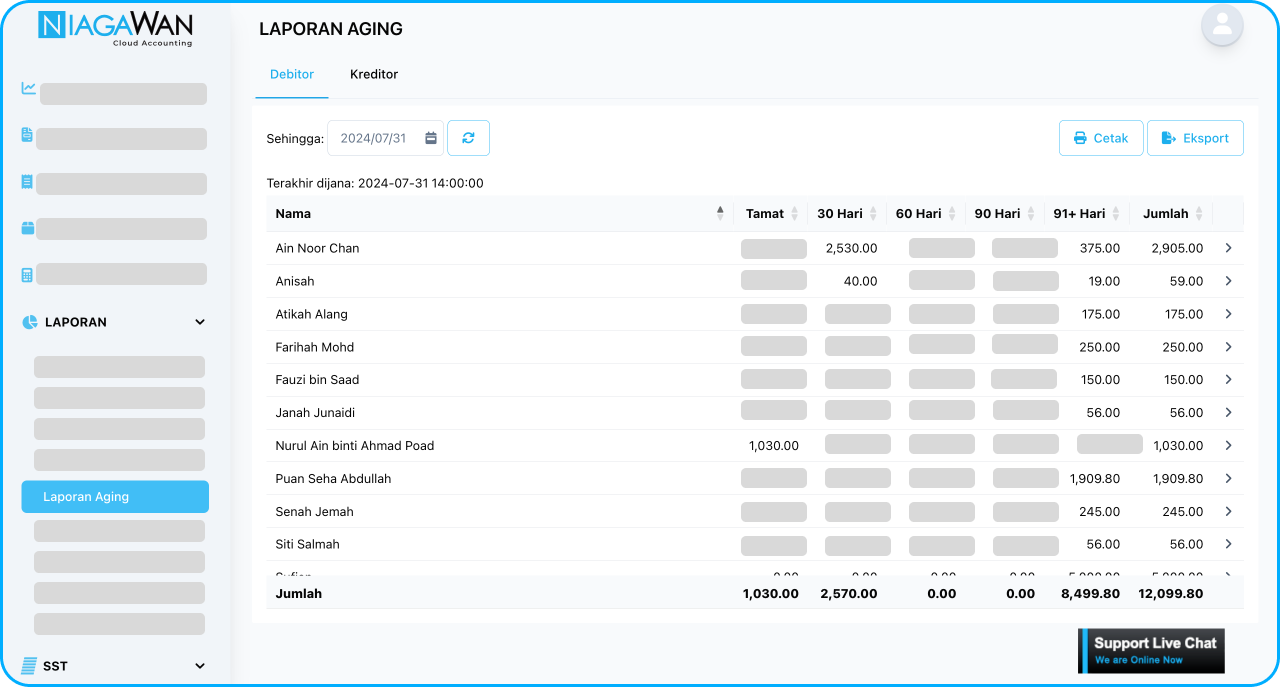
RM17,325 tells you how much is owed. It doesn’t tell you how late it is. See the same RM17,325 sorted by how overdue it is on the aging report page. That’s where you find out that RM6,000 of it has been waiting more than 90 days past due.
With six customers, you can keep this in your head or in a spreadsheet. It gets harder when part payments arrive every week. By then you already know what accounts receivable means. What you need to know is which customer still owes you, on which invoice, and how much they’ve already paid.
05. The Accounts Receivable Process, From Invoice To Money In The Bank
Every credit sale goes through the same five steps. Most payment problems come from skipping one of them.
- 1. Agree the terms before you deliver. How many days, and what happens if it’s late. Put it in the quotation or the customer’s account form, not just a conversation.
- 2. Invoice the same day. The terms usually run from the invoice date, so a late invoice is a late payment. Here’s what a proper invoice needs to show.
- 3. Keep a list of what’s unpaid. One row per invoice: who, how much, when it’s due, how much has come in. That list is your accounts receivable.
- 4. Chase it, and give a receipt when it’s paid. A reminder before the due date, a call after it. When money arrives, give an official receipt that names the invoice and the balance left.
- 5. Match it to the bank. Tick each payment off against your bank statement so you know the money really landed. That’s bank reconciliation.
06. When A Customer Pays Only Part: Partial Payments Explained
A partial payment is when a customer pays some of an invoice, but not all of it. The invoice doesn’t close. It stays open for the balance until the rest comes in. On an invoice list you’ll see it marked “partially paid” or “part paid”. It’s normal.
What Does “Partially Paid” Mean On An Invoice?
The invoice total never changes. Two other numbers do: what’s been paid so far, and what’s still owed. Here’s INV-0990 from section 04 after the first payment:
| Invoice total | Paid so far | Still owed | Status |
|---|---|---|---|
| RM1,800.00 | RM1,000.00 (8 Jul, receipt OR-0214) | RM800.00 | Partially paid |
Only the RM800 is still accounts receivable. The RM1,000 is already in the bank. The invoice stays on your list until the balance reaches zero.
Deposit, Instalment Or Part Of The Bill: Three Kinds Of Partial Payment
| Kind | When it’s paid | What to write down |
|---|---|---|
| Deposit (or down payment) | Before you deliver or start the work | A receipt that says “deposit” and names the quotation or job. It isn’t accounts receivable yet (see the table at the top of this page). |
| Instalments | On dates you both agreed | The amounts and dates in writing, and a receipt for each payment |
| Part of the bill | Whenever the customer can, after the invoice | A receipt for each payment, with the invoice number and the balance left |
How much should a partial payment be? Whatever you and the customer agree. There’s no fixed percentage.
Is A Partial Payment Half? Does It Change The Due Date?
No to both. Any amount less than the balance is a partial payment. RM50 on an RM1,800 invoice counts, and so does RM1,799.
The due date normally stays the same. INV-0990’s RM800 balance was still due on 10 July. If a customer asks for more time on the balance, agree the new date and put it in writing, even in a WhatsApp message. Otherwise you’ll both remember it differently.
What Do You Give The Customer, And What Do You Write Down?
Give one official receipt for each payment, showing the invoice number and the balance still owed. For INV-0990, receipt OR-0214 shows RM1,000 received and RM800 still owed. See filled-in receipts for a job paid in two parts.
Don’t issue a new invoice for the balance. There’s no separate “partial invoice”: it’s the same invoice, for the full amount, with a balance still owed. A second invoice for the RM800 would make it look like the customer owes RM2,600.
How To Ask For A Part Payment Without It Getting Awkward
Ask before the work starts, not after the customer is already late. Put the split in the quotation, then confirm it in plain words:
“Thanks for the order. We’ll take a deposit of RM____ to start, and the balance is due on delivery. I’ll give you a receipt for each payment.”
“No problem paying part first. Let’s agree the date for the balance so I can note it down.”
Which jobs should need a deposit is habit 3 in section 08.
Paying a supplier in parts works the same way, from your side. Their bill (your purchase invoice) stays in what you owe, your accounts payable (section 03), until the last payment. Give each payment its own payment voucher.
07. How To Keep Track Of Who Owes You
You can keep the list in three ways. None of them is wrong. Each one just stops working at a different size.
1 · A FEW INVOICES
📁 A file of unpaid invoices
Works for: a handful of credit customers
Stops working when: customers pay in parts, and you can’t see the balance without doing sums
2 · MORE CREDIT CUSTOMERS
📊 An Excel register
Works for: dozens of invoices, as long as someone updates it
Stops working when: payments come in daily and matching each one to the right invoice becomes a job of its own
3 · PAYMENTS EVERY DAY
💻 Accounting software
Works for: many customers, part payments, more than one person recording
Worth it when: you’re spending too much time checking invoices, payments and outstanding balances by hand
Whichever you use, the list per customer is what accountants call the accounts receivable ledger: every invoice, payment and credit note for that customer, with a running balance. The INV-0990 table in section 04 is a small one.
The Monthly Check: Is Your List Still Right?
Lists drift. A payment gets missed, a credit note never gets recorded. Once a month, do this sum for each customer, or for the whole business:
What they owed at the start + new credit sales − payments received − credit notes = what they owe now
Kedai Runcit Delima, 1 July to 30 September:
RM1,800 owed at the start (INV-0990) + RM2,410 of new invoices − RM1,680 paid − RM120 credit note = RM2,410
That matches the RM2,410 on the list in section 04, so nothing is missing.
If the sum and the list don’t agree, something is missing from one of them. Find it now, while everyone still remembers. And for the other question, how old each amount is, use the aging report.
Before you download: is Excel enough for you?
Excel is enough if you have a few credit customers and one person updates the list.
It starts getting troublesome when customers pay in parts, payments come in every week, or you keep checking invoices against the bank to work out what’s still unpaid.
If that’s already you, it’s worth seeing how Niagawan does it before you set up a spreadsheet.
See how it works in Niagawan →
Or continue with the free Excel register ↓
Download The Free “Who Owes You” Register (Excel)
We built the list as a free Excel file. Type in each credit invoice and what’s been paid. The register works out the rest.
- Who owes you: due date, balance still owed, status (Unpaid / Part paid / Paid), days outstanding, days overdue and age work themselves out. Totals and a summary box at the side.
- Monthly check: the sum above, month by month, with each month’s start carried over.
- Worked example: the RM17,325 from section 04, filled in, including INV-0990 marked Paid.
Free · No sign-up · RM-ready · Last checked September 2026
Downloaded it? Here’s how you’ll know you’ve outgrown it.
The register works well when you only have a few invoices to update. But if you keep asking:
- “Customer paid RM1,000. Which invoice was that for?”
- “How much does this customer still owe?”
- “Did we already record this payment?”
then the problem isn’t the spreadsheet. It’s the time spent keeping it right.
In Niagawan, you record each payment against the invoice it pays, and you can see which invoices are still unpaid or only partly paid.
Ask how Niagawan tracks unpaid invoices →08. Getting Paid Faster: 7 Habits That Shrink What Customers Owe You
You can’t make customers pay, but you can make paying easy and not paying awkward. These are habits, not rules, and none of them needs special software.
- ✅ 1. Put the due date and your bank details on every invoice. “Payment due 3 August 2026” gets paid sooner than “30 days”. Add your account number, or a DuitNow QR, so there’s no reason to wait.
- ✅ 2. Invoice the day you deliver. An invoice sent a week late pushes every due date back a week.
- ✅ 3. Take a deposit on big or custom jobs. If the job is large, or made only for this customer, collect part of it up front.
- ✅ 4. Set a credit limit for each customer. Decide the most you’re willing to have outstanding with them, and start new customers low.
- ✅ 5. Send a monthly statement. One page listing every open invoice and the total. It catches invoices the customer never received, before they become old ones.
- ✅ 6. Keep a reminder rhythm. A friendly note before the due date, a call soon after it, and a firmer step if it keeps slipping. What to say at each age is on the aging report page, and wording you can copy is in the payment reminder templates.
- ✅ 7. Have a stop-supply rule. For example: no new credit while any invoice is more than 60 days overdue. Tell the customer the rule early, so it isn’t personal when you use it.
⚠️ Chase in order of age, not size. A small invoice that’s months overdue is more at risk than a big one that’s a few days late.
09. How Long Do Your Customers Take To Pay? (Collection Days, In Plain Words)
Your terms say 30 days. But how long do customers actually take? You can work it out with one sum:
Money owed to you ÷ credit sales for the period × days in the period = roughly how many days customers take to pay
Our example business: RM17,325 owed today. Credit sales over the last 12 months: RM120,000 (an illustrative figure).
17,325 ÷ 120,000 × 365 = 52.7 days
On 30-day terms, customers are taking about 23 days longer than agreed.
Accountants call this debtor days, or DSO (days sales outstanding). Compare it with your own terms, not with anyone else’s. If you give 30 days and it takes 53 to collect, customers are using you as a free loan for three weeks. If the number rises month after month, collection is slipping, even while sales look fine.
10. Is Accounts Receivable An Asset? And Is It A Debit Or A Credit?
Yes, it’s an asset. An asset is something your business owns that has value, and money customers owe you will turn into cash. Because it’s normally collected within a year, it sits under current assets on the balance sheet, next to cash and stock.
That’s also why your profit and your bank balance can tell different stories. A sale counts as income when you invoice it, not when the customer pays. So you can make a healthy profit on paper while the bank is nearly empty, because the money is sitting in accounts receivable. The profit and loss statement page explains the profit side.
For your accountant: the two entries
When you invoice: Debit Accounts receivable, Credit Sales
When the customer pays: Debit Bank, Credit Accounts receivable
So accounts receivable goes up with a debit and down with a credit, and it normally carries a debit balance. You don’t need to post these by hand to run your business. They’re here so you know what your accountant means.
11. When A Customer Can’t Or Won’t Pay: Credit Notes, Contra And Bad Debts
Not every open invoice ends with a full payment. Before you treat an amount as a problem, check whether it’s one of these:
| Situation | What to do | Read more |
|---|---|---|
| Goods came back, or you overcharged | Issue a credit note. It reduces what they owe. | Credit note |
| You undercharged, or there’s an extra charge | Issue a debit note. It adds to what they owe. | Debit note |
| The customer is also your supplier | Agree in writing to set one amount against the other, and pay or collect only the difference | Contra payment |
| The customer wants to pay, but slowly | Agree an instalment plan in writing, and give a receipt for each payment | Official receipt |
| You’re sure you’ll never get it | Talk to your accountant about taking it off the books as a bad debt | Below |
Bad Debts: When The Money Isn’t Coming
Sometimes a customer closes down, disappears, or simply never pays. Leaving that amount on your list makes your accounts receivable look healthier than it is, so at some point it comes off the books. Accountants call this writing off a bad debt. When to do it, and how it’s treated for tax, is one for your accountant. For a large amount, get legal advice first.
The best protection is the habits in section 08. A customer who is stopped at their credit limit can’t run up a debt you’ll never see.
12. When Tracking Who Owes You Outgrows A Spreadsheet
“Who still owes me, and how much?” shouldn’t take an afternoon of cross-checking invoices against the bank. When it starts to, the list isn’t the problem. Keeping every payment matched to the right invoice is.
That’s the part Niagawan is built around. Each payment is recorded against the invoice it pays, and the aging report shows who owes you and for how long, like the screen in section 04. Niagawan is cloud accounting and POS for Malaysian businesses, used by 40,000+ businesses since 2016.
See how Niagawan tracks unpaid invoices →
Bryant Gan is the Founder of Niagawan — the cloud accounting and POS system used by more than 40,000 businesses in Malaysia since 2016. He has spent over 10 years building software that helps Malaysian SMEs keep their books, stock, and tax records in order.
13. Frequently Asked Questions
What Is The Difference Between Debtors And Accounts Receivable?
Debtors are the customers who owe you money. Accounts receivable is the total amount they owe. In everyday Malaysian business the two words are often used for the same thing, and your accountant may write either on your balance sheet.
Is A Customer Deposit Accounts Receivable?
No. If a customer pays you before you deliver, you owe them the goods or the work, so it is the opposite of accounts receivable. Your accountant records it as a deposit received until you deliver.
What Are Other Receivables?
Money owed to your business that did not come from a sale to a customer. A salary advance a staff member is paying back, or a deposit you paid your landlord, are common examples.
What Is A Good Accounts Receivable Collection Period?
There is no single number that fits every business. Compare your collection days with your own credit terms. If you give 30 days and customers take close to 30, you are collecting well. If the number keeps climbing, your collection is slipping.
Is Accounts Receivable The Same As Revenue?
No. Revenue is the total you have sold. Accounts receivable is the part of those sales you have not been paid for yet. A cash sale adds to revenue but never becomes accounts receivable.
Can Accounts Receivable Be Negative?
A single customer can end up with a credit balance, for example if they paid twice or paid before a credit note was issued. That means you owe them. Check it, then refund it or use it against their next invoice as agreed with the customer.
How Often Should I Review Who Owes Me?
Look at the list every week if you sell on credit a lot, and do the full monthly check at month-end. An aging report once a month shows which amounts are getting old.
What Is A Trade Receivable?
Money customers owe you from selling your goods or services on credit. It is the main part of accounts receivable, and the term you will often see on a Malaysian balance sheet.