
Written by Bryant Gan, Founder, Niagawan · Last updated 1 October 2026
You delivered the goods. The invoice said 30 days. The due date has come and gone, the customer is a regular, and you don’t want to sound rude. So the message keeps not getting sent.
A payment reminder is a short message that tells a customer an invoice is due, or late, and how to pay it. Below is wording you can copy for each stage, from a friendly heads-up to a final reminder letter, as a WhatsApp message, an email and a letter.
Quick answer: Pick the stage that matches how late the invoice is. Copy the message, change the name, invoice number, amount and date, and send it.
01. Which Payment Reminder Should You Send?
It depends on how late the invoice is. Start friendly. Get firmer only as the days add up.
| How late is the invoice? | Tone | Send by |
|---|---|---|
| Not due yet (a few days before the due date) | Friendly heads-up | WhatsApp or email |
| 1 to 7 days overdue | Gentle reminder | WhatsApp or email |
| 8 to 30 days overdue | Firmer, with a new date | Email or a letter, then a call |
| More than 30 days overdue, or no reply | Final reminder | A formal letter by email |
You’ll also see the words outstanding payment. It just means money a customer still owes you on an invoice you’ve already sent. Once the due date passes, that outstanding payment is overdue.
Every example on this page uses the same invoice, so you can see how the tone changes: invoice INV-1015 to Hardware Sejahtera for RM4,120.00, dated 4 July 2026 on 30-day terms, due 3 August 2026. (Names and figures are an example.)
02. Before You Send Anything, Check These 4 Things
A reminder sent by mistake is awkward. Two minutes of checking saves you that.
- ✅ Did the invoice reach them? Check that you sent it, and to the right person. A missing invoice is a very common reason for a late payment.
- ✅ Are the amount and due date right? Look at the invoice itself, not your memory of it.
- ✅ Have they already paid? Check your bank account for a transfer you haven’t recorded yet.
- ✅ Who pays the bills there? The person who placed the order is often not the person who makes the payment. Send the reminder to the one who pays.
For one late invoice, these checks take two minutes. The trouble starts when it isn’t one. With twenty or thirty invoices out, “have they already paid?” means scrolling through your bank app, and “did I already remind them?” means scrolling through WhatsApp. That’s usually how a reminder goes out late, or goes to someone who paid last week.
What you need at that point is one list: every unpaid invoice, who owes it, and how many days late it is. That list is called an aging report, and there’s a free Excel template for it. If you record your invoices and payments in Niagawan Plus, the list is already there. You don’t build it yourself.
03. Before The Due Date: A Friendly Heads-Up
Send this two or three days before the invoice is due. It isn’t chasing. It’s a courtesy, and it catches the “I never got the invoice” problem early.
WHATSAPP MESSAGE
04. Just Overdue (1 To 7 Days): A Gentle Reminder
Most late payments at this stage are an oversight. Keep it light, and make it easy to pay.
WHATSAPP MESSAGE
💡 Always attach the invoice again. It saves the customer from searching for it, and it removes the easiest excuse.
05. One To Four Weeks Overdue: A Firmer Reminder
By now a gentle message has been sent and nothing happened. Be direct. State the facts, ask for payment by a specific date, and ask if something is wrong. This is also the point where a letter starts to make sense.
WHATSAPP MESSAGE
EMAIL OR LETTER · FIRST REMINDER
If a week passes with no reply, call. A two-minute phone call often settles what three messages couldn’t. After the call, send a short message that confirms what was agreed, so there’s a record.
06. More Than A Month Overdue, Or No Reply: The Final Reminder Letter
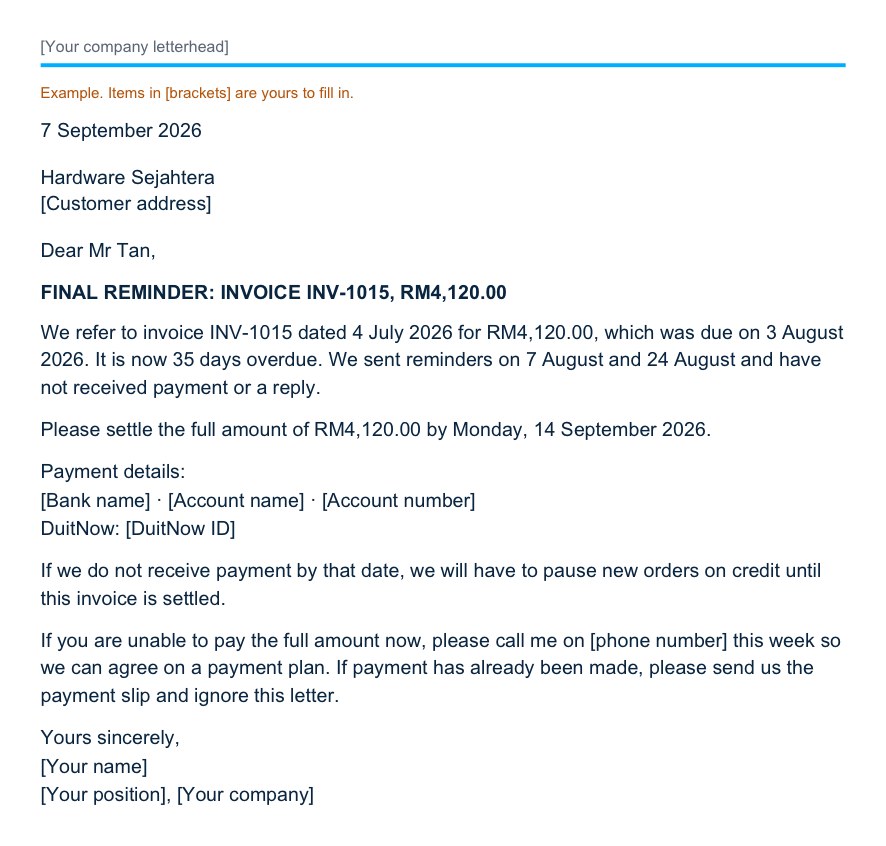
This one is formal. Put it on your letterhead, send it by email with the invoice attached, and address it to the owner or the person who signs off payments. Say what has happened, the date you need payment by, and what you will do next. Keep it factual. No threats.
FINAL REMINDER LETTER
07. One Late Invoice Is Easy. What About Eight At Once?
Hardware Sejahtera is not the only late payer in this example. At 30 September 2026, six customers owe RM17,325 across eight unpaid invoices. Each invoice is at a different stage, so each one needs a different next step. (The same example as the aging report page.)
| Customer | Invoice | Days late | What to do now |
|---|---|---|---|
| Pasaraya Mini Tunas | INV-0912 | 151 | Call. No new credit |
| Bengkel Motor Hafiz | INV-0955 | 112 | Call. No new credit |
| Restoran Sri Melur | INV-0981 | 87 | Call. No new credit |
| Salon Aisyah | INV-0998 | 86 | Call. No new credit |
| Hardware Sejahtera | INV-1015 | 58 | Final reminder sent. Call next |
| Kedai Runcit Delima | INV-1021 | 44 | Final reminder letter |
| Restoran Sri Melur | INV-1038 | 19 | Firmer reminder |
| Kedai Runcit Delima | INV-1042 | 11 | Firmer reminder |
The firmer reminder is in section 05, the final letter in section 06, and what to do after that in section 08.
Look at what it takes to get this right:
- Two customers appear twice. Kedai Runcit Delima and Restoran Sri Melur each have two invoices at different ages. Each should get one message that lists both invoices, not two messages in two different tones.
- The right message depends on the age. A gentle reminder for an invoice that’s 151 days late is too soft. A final letter for one that’s 11 days late is too harsh.
- It changes every week. Someone pays half. A new invoice goes out. Another one crosses 30 days.
With six customers you can still run this from a spreadsheet, as long as someone updates it every time money comes in. Things start slipping when nobody does. Reminders go out late, the wrong customer gets chased, and money you’ve already earned sits in someone else’s account.
What you need is that table, always up to date, without anyone rebuilding it. In Niagawan, each payment is recorded against the invoice it pays, so the aging report shows who still owes you and for how long.
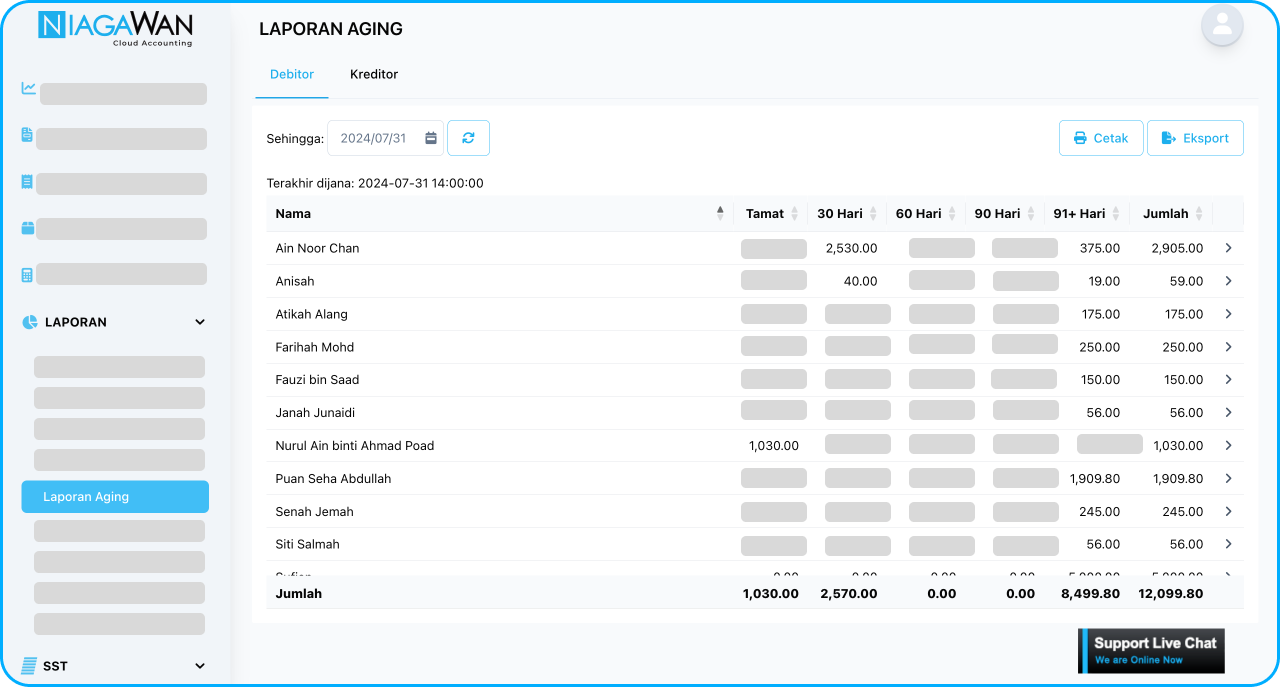
Read it from the right. The 91+ Hari column is money that has waited more than 90 days. Those customers get a call, not another message.
See how Niagawan shows who owes you, and since when →
08. What If They Still Don’t Pay?
A reminder is a request. If it doesn’t work, these are the steps small businesses normally take next:
- Call instead of texting. Ask what’s happening. Sometimes it’s a cash flow problem they were too embarrassed to mention.
- Agree on a payment plan, in writing. Part of the money now is better than all of it never. Record each payment against the invoice. See how to handle part payments.
- Stop giving credit. New orders are cash on delivery until the old invoice is cleared.
- For larger amounts, get advice. The usual next step is a letter of demand, which is a formal letter normally issued through a lawyer. This page doesn’t provide one. Speak to a lawyer about what suits your case.
When the money does come in, send an official receipt that names the invoice it pays.
09. What Should Every Payment Reminder Include?
Whatever the tone, the customer should be able to pay without asking you a single question.
| Include this | Why |
|---|---|
| Invoice number | So they can find it. “The invoice from last month” gets you a reply asking which one |
| Invoice date | Confirms which sale you mean |
| Amount owed, in RM | The exact figure. If they’ve paid part of it, show what was received and the balance |
| Original due date | Shows the payment is late without you having to say so |
| How to pay | Bank name and account number, or your DuitNow ID. Don’t make them look for it |
| The date you need it by | From the firmer reminder onwards. “As soon as possible” is not a date |
| Who to contact | A name and a phone number, in case something is wrong with the invoice |
Not sure your invoice itself is complete? See what a Malaysian invoice should show.
10. Download The Payment Reminder Letters (Word And PDF)
Chasing one or two customers a month? These templates are all you need.
Chasing ten every week? Then the letter isn’t the hard part. The hard part is the list in section 07: who’s overdue, by how much, and whether they’ve paid since you last checked. Niagawan Plus keeps that list for you.
All three letters in one file: first reminder, second reminder, final reminder. Change the details and add your letterhead.
Word ↓Free · No sign-up · RM-ready
The WhatsApp messages and emails aren’t in the download. Copy them straight from sections 03 to 05.
11. What Do Most Businesses Get Wrong?
1. Waiting too long to send the first one. A reminder in week one feels normal. A first reminder in month three feels like a complaint.
2. Chasing the biggest invoice instead of the oldest. The older an unpaid invoice gets, the harder it is to collect. Chase by age, not by size.
3. No invoice number in the message. “Boss, payment?” gets you “Which one?”
4. Only ever calling. Calls work, but they leave no record. Follow each call with a short message.
12. What If There Are Too Many Invoices To Chase From Memory?
Then the wording isn’t your problem any more. Your problem is the list from section 07: who’s late, who paid half, and who you’ve already reminded.
In Niagawan Plus, unpaid and partly paid invoices are listed for you, and the aging report shows how old each one is. When you’re ready to follow up, the invoice can be shared by WhatsApp. You still write the reminder yourself, and the templates on this page work either way.
If chasing payment is eating into your week, ask us. We’ll show you how it looks.
Ask how Niagawan tracks overdue invoices →
Back to the big picture: how to keep track of what customers owe you.
Bryant Gan is the Founder of Niagawan — the cloud accounting and POS system used by more than 40,000 businesses in Malaysia since 2016. He has spent over 10 years building software that helps Malaysian SMEs keep their books, stock, and tax records in order.
13. Frequently Asked Questions
How Many Payment Reminders Should I Send Before The Final One?
Most small businesses send two or three: a gentle reminder in the first week, a firmer one after two to four weeks, and a final reminder after a month. It’s a common rhythm, not a rule. Adjust it to the customer and the amount.
Is It Rude To Send A Payment Reminder On WhatsApp?
No. For many small businesses in Malaysia it’s the normal way to follow up, and a polite message with the invoice attached is easier to act on than a letter. Move to email and a letter once the invoice is a few weeks late, so there’s a formal record.
What’s A Polite Way To Ask For An Overdue Payment?
State the invoice number, the amount and the due date, assume it was an oversight, and make it easy to pay. “Just a gentle reminder that invoice INV-1015 for RM4,120.00 was due on 3 August” is polite and clear. Leave out apologies and long explanations.
What Should The Subject Line Of A Payment Reminder Email Say?
Put the invoice number and the due date in it, for example “Gentle reminder: invoice INV-1015 (due 3 August 2026)”. The customer can then find the invoice by searching their inbox.
Should I Send The Invoice Again With The Reminder?
Yes, every time. It saves the customer from looking for it.
How Do I Remind A Customer Who Has Paid Part Of The Invoice?
Thank them for the payment, state how much you received and on what date, and give the balance that’s still owed with a date for it.
Can I Charge Interest On A Late Invoice?
Only if it was agreed in your terms before the sale. Businesses that charge it normally state it on the quotation or invoice upfront. If you’re not sure what your terms allow, check your agreement or ask a lawyer.
What’s The Difference Between A Payment Reminder And A Letter Of Demand?
A payment reminder is a message you send yourself to ask for payment. A letter of demand is a formal letter, normally issued through a lawyer, and it’s usually the step after your own reminders have failed.