
Written by Bryant Gan, Founder, Niagawan · Last updated 23 September 2026
An official receipt is the document your business gives a customer to confirm you’ve received their payment: how much, when, for what, and how they paid.
Which paper do I give?
Has the money arrived, and did you bill this sale before?
- Paid in full, right now, at the time of sale → cash bill (it already works as their receipt)
- Paying an invoice you sent earlier → official receipt against that invoice
- Paying a deposit or only part → official receipt for the amount received (and invoice the full job)
- Not paid yet → invoice
Three months after a job, a customer tells you, “I paid you in full.” Your book says they still owe RM3,000. If each payment came with a numbered receipt showing what was still owed, that conversation takes one minute instead of one argument.
Below you’ll find a free official receipt template in Word, Excel and PDF, a filled Malaysian example, and what to write in every box.
01. What Is An Official Receipt? (And What Makes It “Official”)
A customer pays you. They want something that says, “Yes, this business received my money.” That piece of paper is the receipt.
In plain terms, an official receipt says four things: you’ve been paid, how much, what it was for, and how the money came in. “Payment receipt”, “official payment receipt”, “official receipt” and just “receipt” are used for the same thing in everyday Malaysian business.
So what makes it “official”? Normally it just means the receipt is issued in your business name, carries your business details, and has its own running number. It isn’t a special government form. There’s no single design you have to copy. What matters is the details and the numbering.
💡 A receipt book from any stationery shop is fine. So is a printed template, or a PDF you send. What makes it useful is that the details are complete and the number is never reused.
You’ll usually need one when:
- A customer pays a deposit and wants proof
- A customer pays last week’s invoice and asks for an “official receipt”
- You collect monthly rent, tuition or membership fees
- A company customer’s finance team won’t process their claim without one
02. Download The Free Official Receipt Template (Word, Excel, PDF)
All four files are free, editable and need no sign-up. Each one is laid out for Malaysian businesses: RM amounts, your SSM number, and a payment-method line with DuitNow QR and bank transfer already on it.
| Format | Best for | Download |
|---|---|---|
| Word (.docx) | Typing each receipt on a laptop, or adding your own letterhead | Word ↓ |
| Excel (.xlsx) | The balance works itself out, plus a Receipt Book sheet that lists every receipt | Excel ↓ |
| PDF, blank | Printing a pad and writing receipts by hand. Two per A4: Customer copy and Office copy | PDF ↓ |
| PDF, filled example | Seeing exactly how a deposit and a final payment are written (the example in section 05) | Example ↓ |
Fill in the invoice total and the payment, and the “balance still owed” works itself out. The second sheet, Receipt Book, keeps one row per receipt so you can see every payment against each invoice.
Download the official receipt template (Excel) ↓Print, cut in half, write by hand. One half for the customer, one for your file.
Download the printable official receipt (PDF) ↓The two receipts from section 05, filled in.
Download the official receipt sample (PDF) ↓Free · No sign-up · RM-ready · Last checked September 2026
A few receipts a month? The template is all you need. Recording payments every day, including deposits and part payments?
Matching each payment to the right invoice by hand gets harder as the pile grows. In Niagawan, you record each payment against the invoice it pays, and you can see which invoices are unpaid or only partly paid. Receipt numbers run on their own.
See how receipts work in Niagawan03. Receipt, Cash Bill Or Invoice: Which One Do You Give?
These three get mixed up because they all have an amount on them. The easiest way to separate them is by what each one is for:
INVOICE
Asks for money
CASH BILL
Records a sale that’s paid on the spot
RECEIPT
Confirms money you’ve received
Two scenes make it obvious. A customer walks in, buys RM80 of goods and pays at the counter. You give a cash bill, and that one paper is both the sale record and their proof of payment. You don’t need a separate receipt as well.
Now a different customer. You sent them an invoice last week for RM500, and today the money arrives. You don’t write a new bill, because the sale was already billed. You record the payment and give them a receipt if they ask for one.
| Situation | What you give | Why |
|---|---|---|
| Customer pays in full at the time of sale | Cash bill | It already records the sale and the payment |
| Customer pays an invoice you sent earlier | Official receipt against that invoice | The invoice asked. The receipt confirms. |
| Customer pays a deposit, balance later | Invoice for the full job + receipt for the deposit | Part paid, part still owed |
| Customer hasn’t paid yet | Invoice | It tells them what they owe and by when |
“Cash” here means paid at the time of sale, not banknotes. If you’re not sure whether a sale is paid now or paid later, that page walks through the decision.
📌 The opposite direction: when you are the one paying out, the internal record is a payment voucher. The receipt then comes from the person you paid. This page is about the other side: money coming in, and the receipt you give.
04. What To Write On An Official Receipt, Field By Field
A receipt with missing boxes is still a receipt. But it’s weak proof. Each field below answers a question someone might ask you months later.
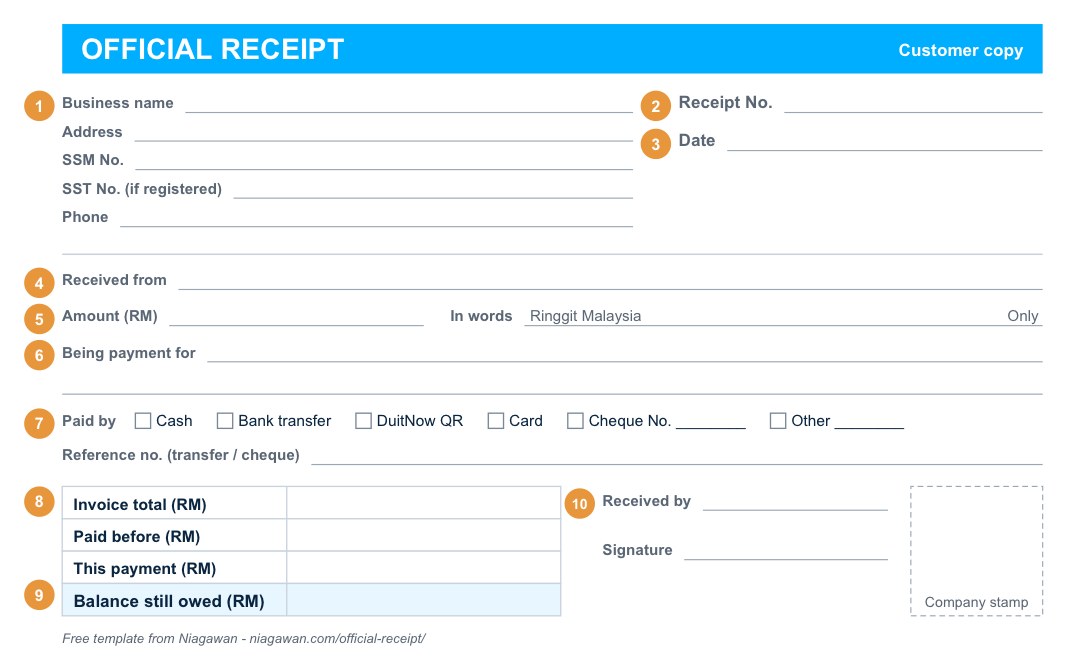
| Field | What to write | What goes wrong without it |
|---|---|---|
| 1. Your business details | Business name, address, SSM number, phone. Add your SST number only if you’re registered. | Nobody can tell who issued it |
| 2. Receipt number | The next running number, e.g. OR-0041 | You can’t trace or match it later |
| 3. Date | The date you actually received the money | Arguments over when they paid |
| 4. Received from | The customer’s name or company name | A company customer can’t file it |
| 5. Amount (figures and words) | RM1,500.00 and “Ringgit Malaysia One Thousand Five Hundred Only” | Figures are easy to alter. Words aren’t. |
| 6. Being payment for | The invoice number, or a short description (“Deposit for invoice INV-0112”) | Nobody knows which invoice it paid |
| 7. Payment method | Cash, bank transfer, DuitNow QR, card, or cheque plus the cheque number | You can’t match it to your bank statement |
| 8. Invoice total and paid before | The full invoice amount and anything already paid | The balance can’t be checked |
| 9. Balance still owed | What the customer still needs to pay (RM0.00 if fully paid) | The customer thinks they’ve finished paying |
| 10. Received by | Name and signature of whoever took the money. Company stamp if you use one. | No one to ask if something’s wrong |
The Two Boxes People Skip Most
Balance still owed (9). Hand-written receipts often leave it out. It’s the one box that stops the “I paid in full” argument, because both sides can see what’s left after every payment.
Being payment for (6). “Payment received” on its own tells you nothing six months later. Write the invoice number. If a customer has three invoices open, this is how you know which one they paid.
05. Example: A Customer Pays An RM4,500 Job In Two Parts
An illustration to show the fields. The business, customer and numbers are made up.
Pakar Sejuk Aircon Services, a small contractor in Shah Alam, is installing three aircon units at Restoran Selera Kampung. The job is invoiced as INV-0112 for RM4,500. The restaurant pays a deposit first, then the rest when the job is done.
Why OR-0041 and then OR-0047? The business issued five other receipts to other customers in between. Numbers run across the whole business, not per customer.
💡 What this example shows: each receipt shows what’s still owed, so nobody argues later. Two receipts, one invoice, and the balance goes RM3,000 → RM0 in writing.
06. Deposit, Part Payment, Rent Or Monthly Fees: What To Write On The Receipt
The layout stays the same. What changes is how you fill in “being payment for” and “balance still owed”.
🔨 Deposit before the job starts
For: “Deposit for invoice INV-0112”
Balance: the rest of the job
Invoice the full job, then receipt each payment against it.
🧾 Instalments or part payments
For: “Part payment 2 of 3 for invoice INV-0098”
Balance: what’s left after this payment
One receipt per payment. Never one receipt that covers money you haven’t received yet. See what a partial payment means for the balance.
🏠 Rent, tuition or membership fees
For: the period it covers, e.g. “Rent for Unit 3A, October 2026” or “Tuition fees, September 2026”
Balance: any arrears, or RM0.00
Writing the period stops the “which month was this for?” question.
💳 Cash, bank transfer or DuitNow QR
For: as normal
Paid by: write the method, and the transfer reference if there is one
⚠️ A cash receipt doesn’t mean banknotes only. It’s a receipt for money received, however it came in.
Keeping track of many part payments across many customers? The real question becomes “who still owes me, and for how long?” That’s what an aging report answers.
07. How To Write An Official Receipt In 5 Steps
Whether you’re using a receipt book or the template, the order is the same.
- 1. Check the money has actually arrived. Count the cash, or check your bank app for the transfer. Don’t go by “I’ve already sent it”.
- 2. Take the next number. The next unused receipt number, in order.
- 3. Fill in every field. Customer, amount in figures and words, what it’s for, payment method, and the balance still owed.
- 4. Sign and hand over the original. The customer gets the top copy, printed or as a PDF.
- 5. Keep your copy and update your records. File the office copy, and mark the invoice as paid or part paid.
💡 Two minutes per receipt. No special software, no special paper.
08. Numbering Receipts And Keeping Your Receipt Book
A receipt number is how you find a payment again. It also shows, at a glance, whether anything is missing.
Good practice for numbering:
- Use one running sequence for the whole business, e.g. OR-0041, OR-0042, OR-0043.
- Some businesses add the year: OR-2026-0041.
- Never reuse a number, and never skip one on purpose.
- Pre-numbered receipt books from the stationery shop do this for you.
❌ Tearing out a spoiled page
✅ Write “CANCELLED” across it and keep both copies
❌ Starting again from 001 each month
✅ Keep one running number
❌ Two books running the same numbers
✅ One sequence, or a different prefix per book
❌ Using the same number twice
✅ Every receipt gets its own number
Made a mistake on a receipt? Don’t correct it with liquid paper, and don’t tear it out. Write “CANCELLED” across it, keep the customer copy and the office copy together, and issue a new receipt with the next number. The gap in your numbers then has an explanation sitting in the book.
These are good habits, not a legal format. They’re what makes your receipt book easy to check, for you, your accountant, or anyone reviewing your records.
09. Paid By Bank Transfer: Do You Still Need To Give A Receipt?
More payments arrive by online transfer or DuitNow QR now than by cash. So owners ask: the customer already has the bank slip, isn’t that enough?
The two papers prove different things.
THEIR BANK SLIP
Shows they sent money
Comes from their bank
Doesn’t say which invoice it paid
YOUR RECEIPT
Shows you received it
Comes from your business
Names the invoice and the balance left
Whether you issue a receipt for every transfer is normally your choice, or the customer’s request. Many businesses issue one only when asked. Company customers often ask for one because their finance team needs it to close off the payment.
One practical habit: write the transfer reference on your receipt copy. When you’re matching payments to your bank statement at month end, that reference ties the line in the bank to the receipt in your book.
⚠️ Only issue the receipt once the money has actually landed. “I’ve already transferred” isn’t the same as money in your account, and a cheque isn’t paid until it clears.
10. Common Receipt Mistakes (And The Fix)
Most receipt problems don’t show up on the day. They show up weeks later, when someone asks a question.
| Mistake | What happens | Fix |
|---|---|---|
| No balance shown | The customer thinks they’ve paid in full | Always fill in “balance still owed”, even if it’s RM0.00 |
| No invoice number | You can’t tell which invoice was paid | Write the invoice number in “being payment for” |
| Amount in words doesn’t match figures | The receipt can be questioned | Write the words last and read both together |
| Duplicate or skipped numbers | Gaps nobody can explain | One running sequence, and CANCELLED pages kept |
| Receipt given before the money cleared | You’ve confirmed money you don’t have | Wait until the transfer lands or the cheque clears |
| No office copy kept | No record of your own | Carbon book, 2-per-page PDF, or save the file |
❌ “Received RM1,500. Thank you.”
✅ “Received RM1,500.00 by DuitNow QR, deposit for invoice INV-0112. Balance still owed RM3,000.00. Receipt OR-0041.”
11. When A Receipt Book Stops Coping
A receipt book works well when a few payments come in each week. It starts to struggle when:
- dozens of payments come in every month, many of them part payments
- you have to flip through the book to find which invoice a transfer was for
- someone asks “who still owes me?” and the answer takes an afternoon to work out
At that point the receipts themselves aren’t the problem. Keeping them matched to the invoices is.
This is where Niagawan Plus helps. You record each payment against the invoice it pays, whether it came in as cash or into the bank. You can see which invoices are unpaid or only partly paid. Receipt numbers run on their own, and you can print or export the receipt list. If a receipt is wrong, you can cancel it without losing the number trail. The payment lands in your cash book too, and you can see who still owes you and for how long.
Niagawan Plus is RM497 a year (excluding SST) with 3 user IDs. Niagawan has served 40,000+ Malaysian businesses since 2016.
5 rules for receipts
- ✅ Only issue a receipt for money that has actually arrived.
- ✅ One running number, never reused.
- ✅ Always write which invoice it pays.
- ✅ Always show the balance still owed.
- ✅ Keep your copy, including cancelled ones.
Bryant Gan is the Founder of Niagawan — the cloud accounting and POS system used by more than 40,000 businesses in Malaysia since 2016. He has spent over 10 years building software that helps Malaysian SMEs keep their books, stock, and tax records in order.
12. Frequently Asked Questions
Is A Cash Bill The Same As An Official Receipt?
They overlap. A cash bill records a sale that’s paid on the spot, so it also works as the customer’s proof of payment. An official receipt is for money that arrives later, against an invoice or as a deposit.
Does An Official Receipt Need A Company Stamp Or Signature?
It’s normal practice to sign it, and many businesses stamp it too, because it shows who received the money. Some customers, especially companies, may ask for both. Check what your customer needs before you hand it over.
Can An Official Receipt Be Handwritten?
Yes. Many Malaysian businesses use a pre-numbered receipt book from the stationery shop. What matters is that the details are complete, the writing is clear and you keep a copy.
Can I Send A Receipt By WhatsApp Or Email As A PDF?
Many businesses do, especially for bank transfers. Keep the same details and numbering as a paper receipt, and keep your own copy of the file.
I Made A Mistake On A Receipt. What Now?
Don’t tear it out or cover it up. Write “CANCELLED” across it, keep both copies, and issue a new receipt with the next number.
A Customer Asks Me For An Official Receipt. What Do I Give Them?
If they’ve paid an invoice or a deposit, give a receipt in your business name with a receipt number, the amount, what it paid for, how they paid and the balance still owed. If they paid in full at the counter and you gave a cash bill, that cash bill already works as their receipt.
Is An Acknowledgement Receipt The Same As An Official Receipt?
Usually not. An acknowledgement receipt normally confirms you received documents or goods. An official receipt confirms you received payment.
Is An Official Receipt The Same As An e-Invoice?
They’re different documents. If your business issues e-Invoices, check with your accountant how receipts fit into your setup. Our e-Invoice page explains the basics.
Does A Receipt Replace A Payment Voucher?
No, they sit on opposite sides. A receipt is what you give when money comes in. A payment voucher is your own record when money goes out.