
Written by Bryant Gan, Founder, Niagawan · Last updated 22 September 2026
Your sales rep paid RM18 for parking and RM42 for a Grab to see a customer. Your technician bought a part at the hardware shop because the job couldn’t wait. You paid the courier bill on your own card. Everyone wants that money back, and you need a record of what it was for.
An expense claim form is the sheet a staff member fills in to get back money they spent for the business, with the receipts attached. Below: a free one in Excel, Word and PDF, a filled RM example, and how a claim moves from receipt to repayment.
Quick answer: Paid for something the business needed? List each receipt on the form, attach them, get someone else to approve it, and get paid back, usually by transfer.
01. What Is An Expense Claim Form?
An expense claim form records money someone spent for the business, out of their own pocket, that the business now pays back. Each line shows the date, what it was for, the amount and the receipt. The total is what the business owes that person.
You’ll also hear it called a staff claim form, an employee claim form or a reimbursement form. Same job.
Who normally uses one:
- Staff who pay for parking, toll, Grab, a customer lunch or a small purchase while working
- A director or the owner who paid a business bill on a personal card
- Anyone travelling for work who pays first and settles up after
1 · YOU PAY
You pay with your own money
2 · YOU CLAIM
You claim it back with receipts
3 · YOU’RE PAID BACK
The business pays you back and records the expense
02. Download The Free Expense Claim Form
Pick the file that fits how you work.
Fill it in on your laptop or phone; the totals add up by themselves. Includes a claims log (one row per claim: approved, paid or still waiting) and a mileage log (trips and km, with one cell for your company’s rate).
Excel ↓Free · No sign-up · RM-ready · Last checked September 2026
Most claim form templates stop at the form; the claims log shows which claims are still unpaid.
Handling more than a few claims a month? Section 10 covers when a spreadsheet stops being enough.
03. What Goes On An Expense Claim Form? (Field By Field)
Each field answers a question someone will ask later: who spent it, on what, and has it been paid back?
| Field | Why it’s there |
|---|---|
| Name, staff ID, department | Who to pay back, and which part of the business the cost belongs to |
| Claim period | The month or trip this claim covers, so one receipt doesn’t turn up in two claims |
| Date of each expense | Puts the cost in the right month in your accounts |
| What it was for | The business reason, not just the item: “Parking, customer visit, Setia Alam” |
| Category | Parking, toll, transport and so on. Each goes to its own expense account (see the chart of accounts) |
| Receipt no. | Matches each receipt to its line. No receipt means the line needs a note (section 08) |
| Amount (RM) | One line per receipt, so each amount can be checked against its paper |
| Total | What the business owes this person |
| Claimed by | Signature and date: the person confirms these were real business costs |
| Approved by | Someone other than the person claiming. This is the check that matters |
| Paid on / payment reference | Ties the claim to your bank statement and closes it |
❌ Parking — RM12
✅ Parking, trade supplier meeting, Klang — RM12 (receipt R6)
04. Example: A Sales Rep Claims RM230.90 For August
Here’s a filled claim form example. Farid, a sales executive at a small air-cond company in Shah Alam, paid with his own money six times in August. On 2 September he hands in one claim for the month. (Names and figures are an example.)
| Date | What it was for | Category | Receipt | RM |
|---|---|---|---|---|
| 5 Aug | Parking, customer visit, Setia Alam | Parking | R1 | 18.00 |
| 5 Aug | Toll, same visit | Toll | R2 | 7.40 |
| 12 Aug | Grab to a customer meeting in KL (car at the workshop) | Transport | R3 | 42.00 |
| 19 Aug | Lunch with a customer (2 people), quotation follow-up | Meals with customers | R4 | 86.50 |
| 22 Aug | Extension cable and cable ties, demo set-up at a customer site | Supplies | R5 | 65.00 |
| 27 Aug | Parking, trade supplier meeting, Klang | Parking | R6 | 12.00 |
| Total claimed | 230.90 |
By category: parking RM30.00 (18.00 + 12.00) + toll RM7.40 + transport RM42.00 + meals with customers RM86.50 + supplies RM65.00 = RM230.90.
The sales manager checks the receipts and approves it on 3 September. The office pays Farid by DuitNow transfer on 5 September and writes the transfer reference on the form.
Farid also drove his own car on three trips, 148 km in total. That goes on the mileage log at the rate his company sets, so it isn’t part of the RM230.90 (section 07).
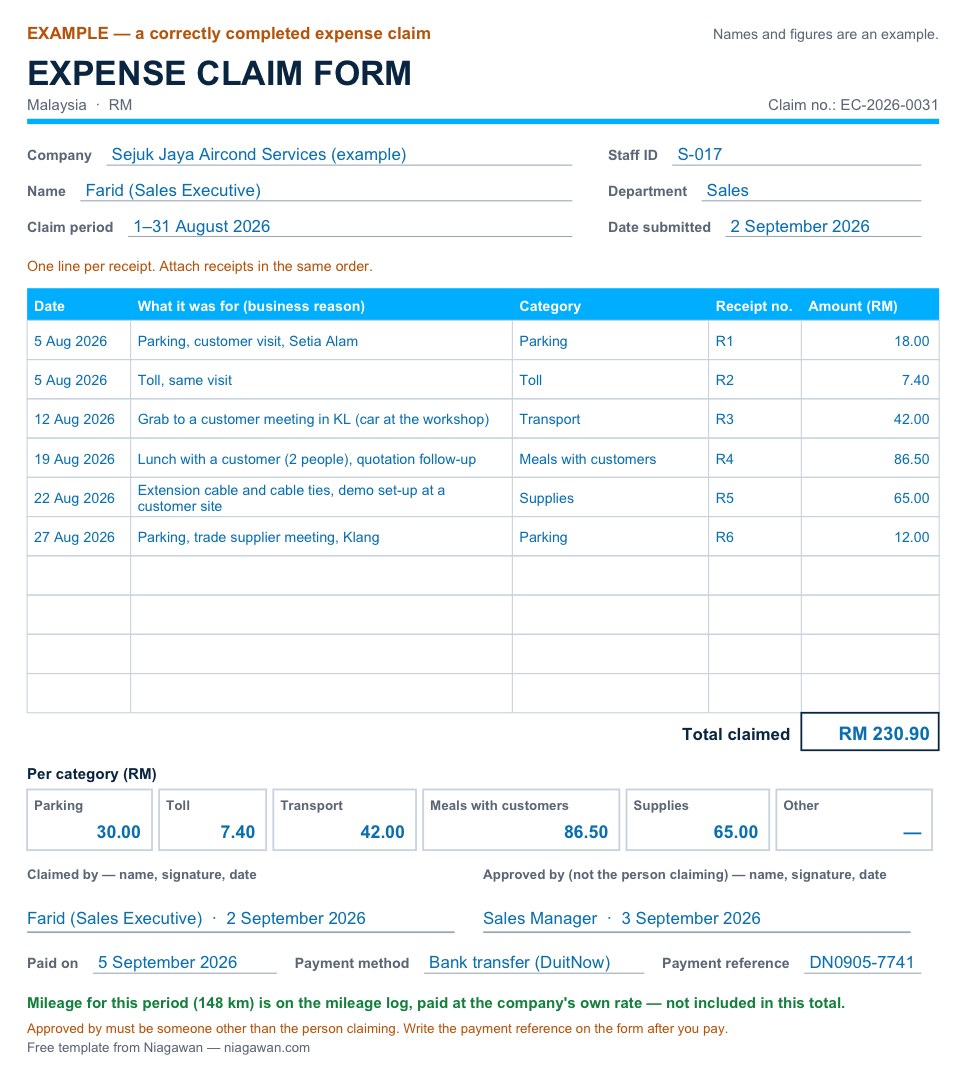
Why this is an expense claim and not petty cash: Farid paid with his own money, and the business paid him back afterwards. If the parking money had come out of the office cash box, it would be a petty cash voucher.
💡 What this shows: One claim a month, one line per receipt, a reason on every line. Six months later anyone can still see what the RM230.90 bought.
05. How An Expense Claim Works, Start To Finish
Most small businesses run their expense claim process something like this:
- 1. Spend and keep the receipt, even for RM5.
- 2. Fill in the form at the end of the month or trip, one line per receipt.
- 3. Attach the receipts in the same order as the lines.
- 4. Someone else checks and approves it. Expense claim approval by a second person is the whole point. (A different person.)
- 5. Pay it back, usually by bank transfer. This is the reimbursement.
- 6. Write the payment reference on the form, so the transfer can be matched on your bank statement later. That’s what bank reconciliation does. (Reference written back.)
- 7. File it with that month’s records, and record the amounts as business expenses.
⚠️ The step people skip: Step 6. Without the reference, the form shows a claim was approved, not that it was paid, so the same claim can get paid twice.
06. Expense Claim, Petty Cash Or Payment Voucher: Which One Do You Need?
All three record money going out. What separates them is whose money paid for it first.
Whose money paid for it?
SOMEONE’S OWN MONEY
Staff, director or owner. E.g. staff paid RM18 parking themselves.
→ Expense claim. The business pays them back.
THE BUSINESS’S MONEY · CASH BOX
Cash from the office cash box. E.g. the clerk took RM18 for parking.
THE BUSINESS’S MONEY · PAID DIRECT
Paid straight to a supplier or person, usually from the bank. E.g. RM1,240 to a packaging supplier.
One overlap: small claims are sometimes paid back in cash from the petty cash box, and some businesses call that a petty cash claim form. Either way, the receipt and the approval matter more than the form’s name.
07. Mileage And Travel Claims
When staff drive their own car for work, fuel usually isn’t claimed receipt by receipt. They keep a mileage log instead, and the business pays an agreed amount per km. That’s what people mean by a mileage claim form.
Each trip is one line: date · from → to · what the trip was for · km driven. Farid’s three trips from section 04 look like this:
| Date | From → to (what for) | Km |
|---|---|---|
| 5 Aug | Office, Shah Alam → customer, Setia Alam → office (customer visit) | 38 |
| 14 Aug | Office → customer site, Puchong → office (installation check) | 64 |
| 27 Aug | Office → trade supplier, Klang → office (supplier meeting) | 46 |
| Total km | 148 |
The rate per km is set by your company. Decide it once, write it down, and use it for everyone. The mileage sheet in the Excel file has one rate cell for it, blank until you fill it in.
Toll and parking aren’t part of the mileage. Claim them as separate lines on the expense claim form, with receipts, like Farid did.
A travel claim form works the same way for out-of-town trips: one claim per trip, with hotel, transport and meals as separate lines.
08. No Receipt, Late Claims And Other Awkward Cases
What If The Receipt Is Lost?
Write a short note on the claim saying what the payment was for and why there’s no receipt, and have someone other than the person claiming sign it.
Keep this rare. A missing receipt now and then is normal. Every month means the process needs fixing.
Someone Hands In Claims From Three Months Ago
Old receipts are hard to check. Set your own cut-off (for example, August’s claims in by early September), write it into your expense claim policy, and tell everyone.
It Was Paid By QR Or E-Wallet
A payment screenshot shows money left the account, not what it bought. Still ask the shop for a receipt.
What About The Owner’s Or A Director’s Own Claims?
Same form. If there’s nobody else to approve it, at least keep the receipts with the claim and record it the same way. Your accountant will ask for it at year-end.
09. What Most Businesses Get Wrong
1. The person claiming approves their own claim. Nobody has checked it. → A second signature, even if it’s the owner’s.
2. No business reason on the line. “Lunch RM86.50” could be anything. → Write who it was with and why.
3. One form covering three months. Costs land in the wrong month. → One claim per month or per trip.
4. Paid back in cash with no record. Nobody can prove it was paid. → Pay by transfer, or have the person sign for the cash.
5. Personal and business items on one receipt. The whole receipt gets claimed. → Circle the business items and claim only those.
6. Paid claims never recorded as expenses. Unrecorded claims make your profit look bigger than it is. → Record each paid claim in the month it belongs to.
Before you approve a claim
- ✅ A date, a reason and an amount on every line
- ✅ A receipt or a signed note for every line
- ✅ The total matches the lines
- ✅ The approver isn’t the person claiming
10. When A Spreadsheet Of Claims Stops Working
For a few claims a month, the Excel file is plenty. What changes is volume. With several staff claiming every month, you’re keeping a folder of forms, copying totals into your books at month-end, and checking the log against the bank to see who’s been paid. Each step is easy. Keeping them all up to date is the hard part.
That’s where recording claims in your accounting system helps. In Niagawan, cloud accounting for Malaysian businesses, each paid claim is recorded as an expense in Niagawan Plus and shows in your reports, from expenses by category to your profit and loss.
Keep the expense claim form and receipts behind each entry: the form shows who approved it, the system holds the record.
Bryant Gan is the Founder of Niagawan — the cloud accounting and POS system used by more than 40,000 businesses in Malaysia since 2016. He has spent over 10 years building software that helps Malaysian SMEs keep their books, stock, and tax records in order.
11. Frequently Asked Questions
Is There A Standard Expense Claim Form In Malaysia?
Not one that private businesses normally have to use. Most use their own, as long as it shows who spent the money, what for, the receipts and who approved it.
How Do I Create An Expense Reimbursement Form?
Use the fields in section 03, or download the Excel or Word template above and change what you need.
Do I Need A Separate Form For Every Receipt?
No. One form per claim period, usually a month, with each receipt on its own line.
Is An Expense Claim The Same As An Allowance?
No. A claim pays back what someone actually spent; an allowance is a fixed amount paid whether it’s spent or not. A claim that pays back actual business spending, with receipts, is normally treated differently from a fixed allowance, so check how your payroll and tax agent handle it (general guidance: hasil.gov.my).
Should Claims Be Paid Back In Cash Or By Transfer?
Either works, but a transfer leaves its own record. If you pay cash, have the person sign that they received it.
Can I Use This Form For An Advance Before A Trip?
Not directly. An advance is money given before anything is spent, so the person owes it back until they claim against it. Record the advance separately, then use the claim form after the trip.